Bhagavad Gita Chapter 9, Verses 20-34: Leaf, Flower, Fruit, Water
The offering anyone can make and the promise none lose
The Wheel of Return
The two armies still stood facing each other across the sacred plain of Kurukshetra, bows lowered, conches silent, while Krishna went on speaking to Arjuna in the space between them. He had already shown Arjuna a world sustained moment to moment by a power no eye could see. Now he turned to a plainer, harder question, one that troubled every worshipper who had ever prayed for something in return. What becomes, he asked, of those who worship not out of love but out of appetite?
Those who follow the letter of the three Vedas, he said, who drink the soma pressed and offered at the sacrifice, who pray to Indra for a place among the immortals, do in fact reach that heaven. For a time they taste pleasures no mortal palate has known, moving among the gods as honored guests. But that pleasure is bought with merit, and merit is a coin that spends. When it runs out, they fall back into the world of birth and death, no nearer to what they truly wanted than when they began. It is, Krishna said, a wheel: sacrifice, heaven, exhaustion, return, and sacrifice again, turning without end because the desire underneath it was never examined.
Against that wheel he set something else entirely. In verse 9.22 he tells Arjuna that for those who think of nothing else, who hold him in mind without division, ananya bhakti, he personally carries what they lack and preserves what they already hold, yoga kshema vahamy aham. Yoga is what is needed but not yet in hand; kshema is what has been gained and must be kept safe. This is not a ledger of merit traded for a temporary residence in heaven. It is an ongoing relationship of care that does not expire when an account runs dry.
Wherever the Prayer Is Sent
Arjuna might well have asked next what became of those who prayed to other gods altogether, not to Krishna by name at all. Krishna answered before the question could be voiced. Even those who worship other deities with faith, he said, are in truth worshipping him, though not in the way the tradition intends, avidhi purvakam, without quite knowing whom they are finally addressing. He is the enjoyer and the lord of every sacrifice, whichever name is called out at the altar and whichever form receives the offered flame. But not knowing this, such worshippers stumble. They do not know him in his true nature, and so, he said, they fall, cyavanti, drifting back toward the very desires that sent them to the altar in the first place.
Then he laid out something closer to a law than a judgment. Verse 9.25 states it plainly: those who worship the gods, the devas, go to the gods; those who worship the ancestors, the pitrs, go to the ancestors; those who worship spirits, the bhutas, go to the spirits; but those who worship him come to him, mad yajino 'pi yanti mam. This is not a punishment handed down from outside for choosing wrongly. It reads more like an observation about how attention works. A person arrives, in the end, wherever their longing has been quietly pointed the whole time, because worship is simply sustained attention given a name and a form.
Krishna was not condemning the worship of ancestors or of lesser powers. He was naming its ceiling. Each destination is real, each is earned, and each is also, by its nature, temporary, bounded by the limits of the thing being sought. Only the horizon a person actually aims at determines how far the arrow can fly.
A Leaf, a Flower, a Little Water
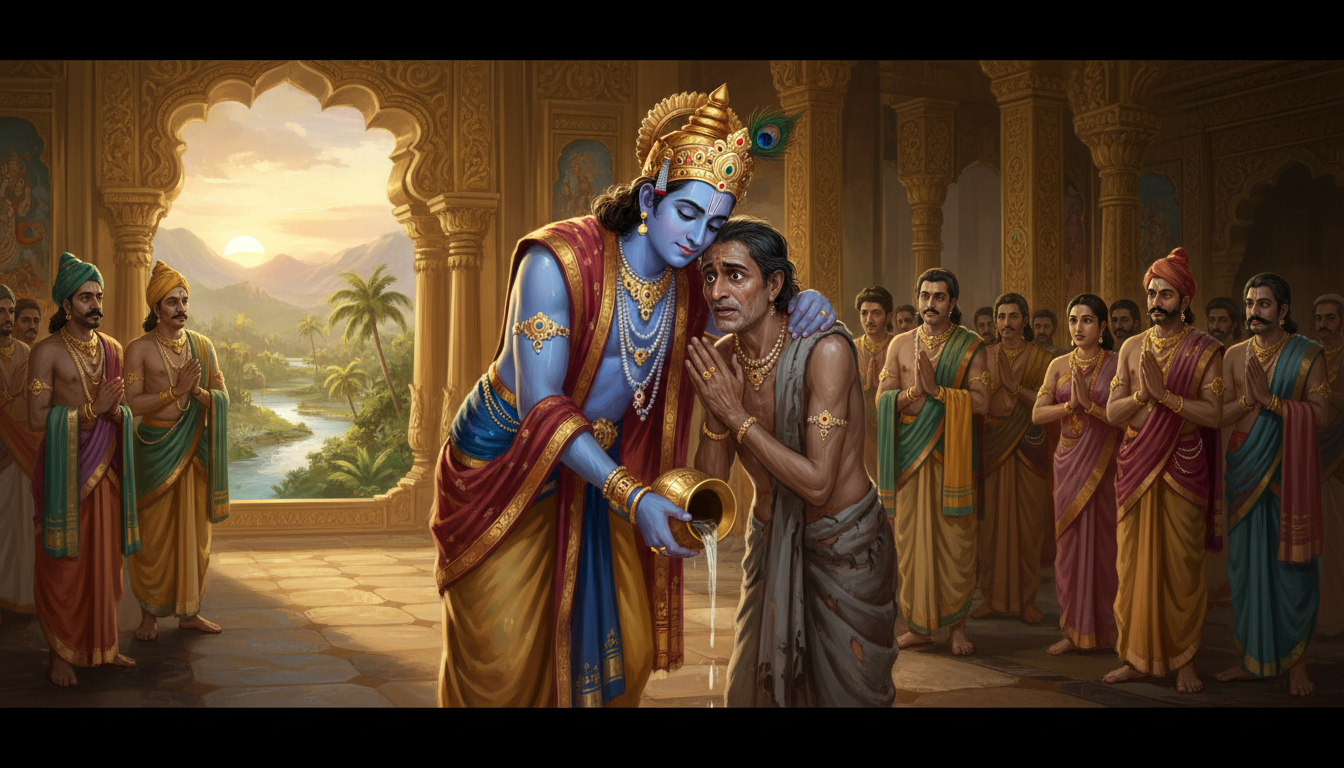
Then, deliberately, Krishna made devotion cheap to enter. In verse 9.26, patram puspam phalam toyam, he tells Arjuna that whoever offers him a leaf, a flower, a fruit, or water, with devotion, he accepts that offering, tad aham bhaktyupahritam asnami, so long as it is given by one whose self is disciplined and sincere. No gold is required. No elaborate rite, no fluency in Sanskrit, no standing of birth or wealth stands between the offering and its acceptance. The cost of entry into this relationship is not what the hand holds but what the heart intends.
Arjuna, seasoned in the grand yajnas of kings, might have found this almost too simple, but that was the point. A poor traveler with nothing but a leaf plucked from the roadside, or a handful of river water, stands on exactly the same ground before Krishna as a monarch pouring ghee into a roaring sacrificial fire. What is weighed is never the market value of the gift.
Krishna then widened the frame past any single ritual moment. In verse 9.27 he tells Arjuna, whatever you do, whatever you eat, whatever you offer in sacrifice, whatever you give away, whatever austerity you undertake, do it as an offering to me, kurusva mad arpanam. Worship no longer waits for an altar to be built or a festival day to arrive. Eating a meal, doing a day's work, giving alms, keeping a private discipline, all of it becomes worship the moment the doer dedicates the act rather than hoarding it as their own achievement. The temple's threshold, in this teaching, quietly extends itself into the kitchen, the field, and the ordinary hours of a life that never otherwise pauses for ritual.
No Favorite, No Enemy
A listener might reasonably wonder whether this kind of devotion makes Krishna partial, loving some more than others simply because they turned toward him. He answered the doubt directly. I am the same toward all beings, he said, none is hateful to me and none is dear, samo 'ham sarva bhuteshu na me dveshyo 'sti na priyah. And yet, he continued, those who worship me with devotion are in me, and I am in them, ye bhajanti tu mam bhaktya mayi te teshu capy aham. Equality, in his telling, is not the same as distance. A sun gives its light without favoring any single field, but a field that turns its leaves toward that light draws something from the relationship that a shaded one does not.
He went further still, in words meant to startle. Even one of the very worst conduct, su duracharah, who worships him with unwavering devotion, should be considered righteous, for he has resolved rightly, samyag vyavasito hi sah. Quickly such a person becomes dharmatma, righteous of soul, and comes to lasting peace. Then came the declaration Arjuna would carry with him longest: kaunteya pratijanihi, na me bhaktah pranasyati, son of Kunti, know this for certain, my devotee never perishes.
For a listener raised on a strict accounting of karma, action weighed exactly against consequence, the promise sounded almost reckless. But Krishna's own phrasing guards against reading it as license. He says the wrongdoer quickly becomes righteous, not that wrongdoing continues unaltered while reward is paid out regardless. The turning itself, sincere and undivided, is what begins reshaping the person from the inside, not a loophole discovered in the ledger.
A Door Anyone Can Walk Through
Krishna carried the promise as far as it would go. In verse 9.32 he tells Arjuna that taking refuge in him, even those the verse calls of sinful birth, papa yonayah, women, vaishyas, and shudras too, striyo vaisyas tatha sudras, reach the highest goal, param gatim. It is worth being honest about what that sentence was doing in its own time. In the world that produced the Gita, access to Vedic ritual and to the recitation of scripture was fenced by caste and by gender; the great sacrifices belonged to the twice born alone. Set against that fence, this verse makes a genuinely radical claim, that the door to the highest goal was never locked in the first place, only the ritual door was. That deserves to be taken seriously as a historical fact about the text.
It is equally worth being honest about the sentence's own shape. It names women and two of the four social classes in the same breath as sinful birth, an idiom that assumes the very hierarchy it is arguing its way past. Reading it fairly today means holding both truths at once: the verse dismantles a barrier while still speaking in the language of the barrier it dismantles. Neither fact cancels the other, and smoothing away the discomfort would miss the honesty of what the passage is actually doing.
The section closes, in verse 9.34, on a single instruction: fix your mind on me, be devoted to me, worship me, bow down to me; unite your very self with me, take me as the highest goal, and you will come to me. What these fifteen verses build, from the exhausted heaven of the ritualist to the leaf and water anyone can lift, is one claim carried through every turn of the argument. The sacred was never metered by wealth, ritual fluency, or the accident of birth. It answers only to whether the offering, however small, carries the whole of the person making it.
Dharma Lesson
Devotion is not a transaction that can be outbid by wealth, ritual skill, or birth; a leaf or a little water offered with a whole heart outweighs an elaborate sacrifice offered with a divided one. Merit earned through ritual is a coin that eventually spends itself, but a mind fixed without division on the source of all things is met with an unbroken, ongoing care. What a person becomes is shaped by where their attention has been resting all along, not by the size of what their hands can afford to give.