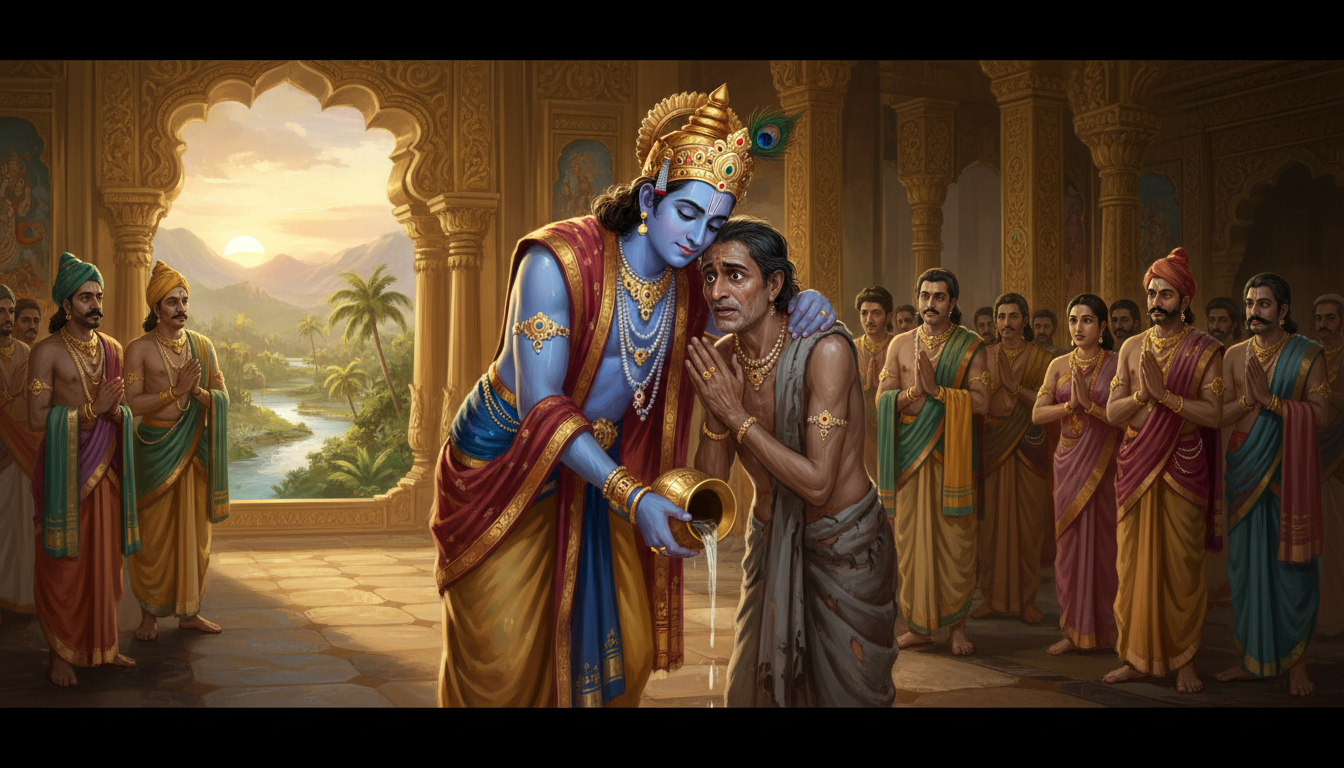
Bhagavad Gita Chapter 9, Verses 1-19: The Sovereign Secret
In me and not in me: the great paradox
The Sovereign Science
The ninth chapter opens with Krishna raising his voice slightly, the way a teacher does when the material is about to change register.
Verse 9.1: to you, who do not carp, I shall declare this most secret knowledge together with its realisation, knowing which you will be released from what is inauspicious. The word he uses of Arjuna is anasuyave, to one without a sneer. It is a small qualification with a large implication. The teaching is not being withheld from the unqualified by some priestly gatekeeping; it is being offered to a listener who is not going to argue with it before he has tried it.
Verse 9.2 is the chapter's manifesto, and every clause in it is a claim: raja-vidya raja-guhyam pavitram idam uttamam, pratyakshavagamam dharmyam su-sukham kartum avyayam. This is the sovereign science and the sovereign secret, supremely purifying, directly verifiable, in accord with dharma, joyful to practise, and imperishable.
Two of those are worth pausing on. Pratyakshavagamam means it is known by direct perception. Krishna is not asking to be taken on authority; he is saying the teaching produces evidence in the person who practises it, and can be checked by them. And su-sukham kartum means pleasant, even easy, to carry out - a startling thing to say in a tradition whose respected paths involved fasting, heat, silence and the mortification of the body.
Verse 9.3 supplies the counterweight so the offer is not mistaken for a triviality. Those who have no faith in this dharma, Krishna says, do not reach me; they return to the road of death and rebirth. The gate is wide, and the practice is pleasant, and neither of those facts makes it optional.
In Me and Not in Me
Then, three verses in, the chapter ties a knot that it never afterwards unties.
Verse 9.4: maya tatam idam sarvam jagad avyakta-murtina. All this world is pervaded by me in my unmanifest form. All beings rest in me - mat-sthani sarva-bhutani - and I do not rest in them.
Verse 9.5 then contradicts the sentence directly before it. And the beings do not rest in me. Na ca mat-sthani bhutani. Behold my sovereign yoga, Krishna says: I sustain beings and I am not in them, and my self is what brings them into being.
A reader is entitled to stop here, and should. Within the space of two verses Krishna has said that all beings rest in him and that they do not rest in him, and he has done it deliberately, flagging the contradiction himself with the words pasya me yogam aisvaram - look at my sovereign yoga. The paradox is the teaching, not a flaw in it.
Verse 9.6 gives the image that lets a person live with the contradiction rather than dissolve it. As the mighty wind, moving everywhere, rests always in space, so all beings rest in me. Understand it so.
The wind is in space. Space is not in the wind, and is not disturbed, thinned or exhausted by anything the wind does. A gale can flatten a forest and the space it moved through is unchanged. So the beings are held without the holder being implicated in them, contained by something they cannot contain in return.
Commentators have argued the point for centuries, some reading the first half as truth and the second as a concession, others the reverse. The verses themselves let neither win. What Krishna is refusing is the tidy answer: that the world is simply real and separate, or simply an illusion with nothing in it. He asks Arjuna to hold both hands open at once.
Seated As If Indifferent
From the paradox Krishna moves to the machinery, and the tone becomes almost administrative.
Verse 9.7: at the end of a kalpa, all beings enter into my prakriti, my own nature; at the beginning of a kalpa, I send them forth again. Verse 9.8 repeats it with the emphasis on the doing: prakritim svam avastabhya visrijami punah punah - taking hold of my own nature, I send forth again and again this entire multitude of beings, powerless as they are under the control of that nature. The word avasam appears here, the same helplessness the eighth chapter named. Nothing in the host of beings arranges its own arrival.
Then verse 9.9, which is where the section becomes interesting. And these actions do not bind me, Arjuna. I remain seated as one indifferent, unattached to those actions - udasina-vad asinam asaktam teshu karmasu.
Everything turns on the small syllable vat. As if indifferent. Not indifferent. The verse takes care not to describe a cold deity who does not care what happens to the creatures it manufactures, and it equally refuses to describe one entangled in the results. What is being pictured is a doer whose doing leaves no residue in him.
Verse 9.10 completes it: under my supervision, prakriti gives birth to the moving and the unmoving - mayadhyakshena prakritih suyate sa-caracaram - and by this cause, Arjuna, the world revolves. Nature does the work; the presence that oversees it does not step in as one more force among forces.
And here is the reason these verses matter to a man in a chariot. Krishna has spent chapters telling Arjuna to act without grasping at the fruit of the act. Now he describes himself doing precisely that, on the scale of universes: full engagement, endless production of consequences, no attachment whatever. The instruction Arjuna has been given is not a rule imposed from outside. It is a description of how the one giving it operates.
Those Who Dismiss the Human Form
Verse 9.11 turns, for a moment, sharp. Avajananti mam mudha manushim tanum asritam. The deluded despise me when I have taken a human form, not knowing my higher nature as the great lord of beings.
The line lands with unusual force given who is speaking it and where. The man saying it is holding the reins of a chariot. On both sides of that chariot stand tens of thousands of people who know him as a cousin, an ally, a negotiator whose embassy failed, a man who was raised among cowherds. Very few of them are looking at him and seeing what he has just described. Duryodhana, when offered a choice between Krishna's armies and Krishna himself standing unarmed, took the armies.
Verse 9.12 gives the consequence, in a hammering line: moghasa mogha-karmano mogha-jnana vicetasah. Vain in their hopes, vain in their actions, vain in their knowledge, senseless. Not punished, note - simply empty-handed, having invested in the wrong reading of what was in front of them.
Against that, verse 9.13 sets the mahatmas, the great souls, who take refuge in the divine nature and worship with undistracted mind, knowing him as the imperishable source of beings. Verse 9.14 describes their practice without any mystery in it: constantly glorifying, striving, firm in their vows, bowing, worshipping with devotion, ever steadfast.
And then verse 9.15, which is unexpectedly generous. Others, worshipping with the sacrifice of knowledge, approach me as the one, as the many, and as facing in all directions - ekatvena prithaktvena bahudha visvato-mukham. Three modes are named and none of them is corrected. The person who sees a single reality, the person who sees many powers, and the person who sees a presence turned toward every direction at once are all described as worshipping, and all of them are said to arrive.
I Am the Rite and the Fire
The section ends with a list, and the list is the argument.
Verse 9.16: I am the rite, I am the sacrifice, I am the offering to the ancestors, I am the healing herb, I am the mantra, I am the clarified butter, I am the fire, and I am the act of offering itself. Aham kratur aham yajnah svadhaham aham aushadham, mantro 'ham aham evajyam aham agnir aham hutam.
Read it slowly and notice what has been done. A sacrifice has parts: a formula, a priest, a substance poured, a flame that receives it, an intended recipient. Krishna does not claim to be the recipient. He claims to be every component, including the ghee and the pouring. Nothing in the ceremony is left over to be merely equipment.
Verse 9.17 extends this to family and scripture: I am the father of this world, the mother, the sustainer, the grandfather; the knowable, the purifier, the syllable Om, and the Rig, the Sama and the Yajur.
Verse 9.18 extends it to relationship: the goal, the supporter, the lord, the witness, the abode, the refuge, the friend; the origin, the dissolution, the resting place, the treasure, the imperishable seed. Suhrit, in that string, means the one who wishes well without being asked and without expecting return, and it is a startling word to find between lord and witness.
Verse 9.19 finishes without flinching. I give heat; I withhold the rain and send it forth; I am immortality and also death; I am being and non-being. Amritam caiva mrityus ca sad asac caham arjuna.
That last pairing is the reason a soldier is being told all this on a morning when the killing is about to start. The teaching does not hand death over to some other power to keep the divine clean. And for a reader with no altar and no chariot, the section's offer stands where it was set down in verse 9.2: this is claimed to be directly verifiable, which is an invitation to test it rather than a demand to believe it.
Dharma Lesson
Krishna offers the ninth chapter's core teaching as something to be verified rather than believed, and then refuses to make it tidy: all beings rest in him, and they do not rest in him. Holding both halves is the discipline the chapter asks for. The list that closes the section leaves no neutral ground, since the rite, the fire, the offering, the father, the mother, and death itself are all named as the same presence.