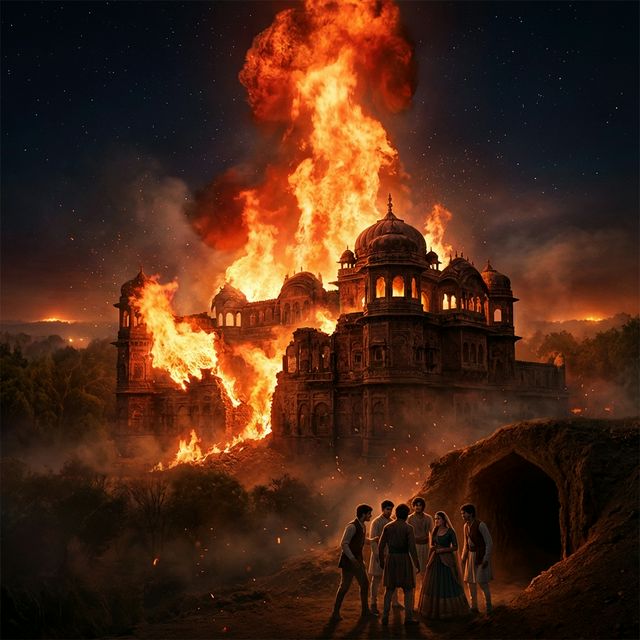
The House of Lac
Duryodhana had sent the Pandavas to Varanavata under the appearance of honor, to attend a festival of Shiva said to be the finest in the land, and Purochana had gone ahead of them to build the house they would live in during their stay. He built it well, by every outward measure, timber and thatch and fine hangings, and laced through it all, hidden in the walls and the beams, lac and resin and every other substance that would answer eagerly to flame. It was a house built to be admired for a season and then to become a pyre.
Vidura, who trusted no gift that came from that quarter of the family, had warned Yudhishthira before they ever left Hastinapura, speaking carefully, in a tongue few at court could follow, of the danger waiting for them at the end of the road. He had gone further than warning: a miner, sent quietly ahead on his instruction, had already begun digging a tunnel from beneath the house toward the riverbank, a passage the Pandavas alone knew existed.
So the family arrived at Varanavata warned, prepared, and outwardly at ease, taking up residence in the house exactly as Duryodhana and Purochana intended them to, giving no sign that the trap had already been recognized and answered before it was ever sprung. Kunti kept the household as she always had, receiving the town's goodwill, its gifts, its curious visits, while beneath the lacquered floor a passage to the river grew longer by the night, waiting for the one evening it would be needed.
A Feast for the Poor
It was Kunti's custom, as it was the custom of the pious in every generation, to mark certain days with a feeding rite, inviting brahmins and the poor of the town to eat at her table and receive alms before they went their way. At Varanavata she kept the custom as faithfully as she had kept it in Hastinapura, and on the night the tunnel beneath the house had finally reached its full length, she held such a feast, filling the lac house with guests who had no notion of what lay hidden in its beams.
Among those who came was a nishada woman, a hunter's wife from one of the settlements outside the town, and her five sons, grown men all of them, broad and strong in the way of people who lived by the forest rather than the court. They ate at Kunti's table with the rest, accepted what was given them with the gratitude of people for whom such a meal was not a common thing, and stayed on after the other guests had begun drifting back to their homes for the night.
There was wine at the feast, offered freely as such feasts offered it, and the nishada woman and her sons did not leave when the hour for leaving had properly come. They lingered instead, drinking further into the evening than the departing brahmins had, growing looser and louder in the emptying hall while the house settled into its last ordinary night, unaware that its walls were built to answer to fire and that the household keeping them company had already dug its own way out from underneath it.
The Ones Who Stayed
By the deep hours of the night, the nishada woman and her five sons had drunk themselves past waking, sprawled senseless in the part of the house given over to the feast, guests who had simply stayed too long at a table too generously kept. Elsewhere in the same house, Purochana had settled into his own quarters for what he believed would be an ordinary night's watch before the appointed hour of his own plan, and wine had found him too, dulling a man who had meant to stay sharp enough to set the fire himself once his intended victims were asleep.
The Pandavas, forewarned since Hastinapura, moved through their own house that night as people move through a place they are about to leave for good, quietly, purposefully, gathering what little they meant to carry and waking no one who did not already know what the night required of them. Yudhishthira gave the word when the household had gone as still as it would go, the drunken guests undisturbed in their corner, Purochana undisturbed in his.
Kunti moved her sons toward the hidden passage beneath the floor, the tunnel Vidura's miner had carved through weeks of patient, secret labor, its mouth opening onto the dark riverbank beyond the house's walls. Above and behind them, the lac house stood exactly as Purochana had built it, timber and resin and hidden accelerant, holding six sleeping people who were not the six it had been built to kill, and one family already halfway down into the earth, leaving it behind.
Bhima Sets the Fire
It fell to Bhima to finish what Purochana had built the house to do to them, and he did it without flinching from the weight of the act, understanding better than any of his brothers what the fire would mean for the people sleeping in it. He moved through the house one last time before the family committed itself to the tunnel, and where the resin and the lac lay thickest in the walls and beams, exactly where Purochana's builders had hidden it, he set the flame that the house had been waiting all along to answer.
The fire caught fast, faster than ordinary timber would have caught, racing up through walls that had been prepared for precisely this outcome though never for these particular victims. Bhima did not linger to watch it take hold. He turned from the spreading light and went down after his mother and brothers into the tunnel's mouth, the last of the family to leave the burning house behind him, sealing their passage into the dark riverside earth while the building they had lived in for weeks began to come apart above them in flame.
Behind him, in the parts of the house neither he nor his brothers had any further reason to think of as anything but finished business, the nishada woman and her five sons slept on through the smoke exactly as Purochana slept on through it in his own quarters, none of them waking to a danger that had never been built with any of them in mind. The fire did not distinguish between the guests it found and the family it had been meant for. It simply burned what it was given.
What the Ashes Showed
By morning the house of lac was a blackened frame open to the sky, and the people of Varanavata who came to see what had happened to the visiting princes found, among the ruins, six bodies burned past any ordinary recognition: a mother's shape and five grown sons beside her, and, apart from them, the remains of the man who had built the house and was presumed to have died trying to save his royal guests, or perhaps in some accident of his own contriving. The count satisfied every searcher who came looking for it. A mother, five sons, and the builder himself, six deaths where six deaths had been expected, and no one who found those ashes had any reason to look past what they were so plainly shown.
Word of the tragedy traveled back to Hastinapura long before the Pandavas themselves did, moving overland while the family Bhima had led out through the tunnel still journeyed in secret toward the forest, alive and unrecognized. Vidura, who had built the escape into the plan from the start, heard the report of the fire and the six bodies with a grief he did not have to feign for the court watching him, and a private understanding he shared with almost no one, that the report was true in every particular except the one that mattered most.
The epic that follows the Pandavas through exile and return, through every alliance and every battle still ahead of them, does not pause again over the six who burned at Varanavata. The nishada woman is given no name. Her five sons are given no names either, no lineage, no voice, nothing but the service their deaths performed for a family the tradition considered worth remembering in full. Purochana's death sits beside theirs in the same fire, the architect caught in the very trap he had built, but even his end is recorded chiefly for what it meant to Duryodhana's plan, not for what it cost him. The tunnel had bought six lives with six others, and the story that saved itself the trouble of counting the second six moved on to the parts of itself it had already decided were worth telling.
Dharma Lesson
The survival of the righteous is sometimes bought from people the story does not think to name. The nishada woman and her five sons pay, with their lives, for a tunnel and a fire that was never meant for them, and the epic that remembers every Pandava's name in exhaustive detail does not trouble to record theirs. It is a debt the tradition leaves standing, unpaid and largely unexamined, and it is worth noticing exactly because the text moves past it so quickly.