The Question from the Bed of Arrows
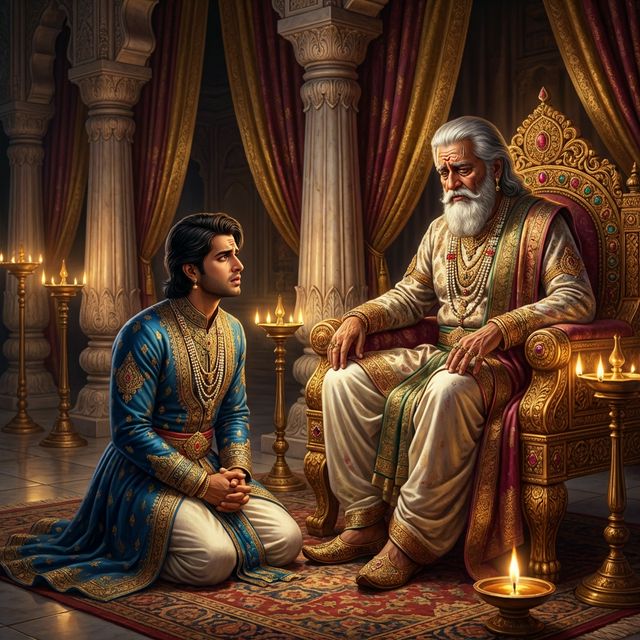
The winter sun crossed slowly over Kurukshetra, and beneath it, on his bed of arrows, Bhishma lay as he had lain for many days, waiting for the solstice that would release him into death. Physicians came and went, kings came and went, and still the old regent held court from that terrible bed, teaching what he had learned across two lifetimes of duty. Yudhishthira came again that morning, dust of the ravaged field still on his sandals, and sat at the grandsire's side with a question he had carried since the war ended and could no longer keep unspoken.
"Grandfather," he said, "tell me something that has troubled me more than my grief. We fought for dharma, and dharma bled with us at every step. Yet I have watched wicked men prosper all my life, kingdoms of cruelty stand unshaken for generations, while the righteous are ground down like grain between stones. Duryodhana himself flourished for thirteen years after the dice game, untouched, while we starved in forests. Why does fortune seem to favor the very men who least deserve it? Does virtue truly guard a house, or is that only what we tell ourselves to bear our losses?"
Bhishma's eyes, sunk deep with pain and age, brightened faintly at the question, as they always did when a true one was asked of him. "You ask what kings have whispered since the first kingdom was founded," he said. "I will not answer you with a sermon, Yudhishthira, but with a story the old sages tell of Shakra himself, the lord of the gods, and of an asura named Shambara whose fortune not even heaven could break. Listen, and you will find that fortune is never as blind as it appears."
The Wanderer at Shambara's Gate
"There was an age," Bhishma began, "when the asura Shambara held a fortune that troubled the three worlds. He was an enemy of the gods by birth and old enmity, a lord of cities and treasuries and warriors beyond counting, and though Indra had struck at him again and again in the wars of gods and demons, Shambara's house did not fall. Wealth multiplied around him as though it loved him. Armies that should have been broken by heaven's thunderbolts regrouped and served him still. Indra, seated on his own throne amid his own splendor, found this intolerable and, more than intolerable, mysterious. Other asuras of equal power had been humbled in a single season. Shambara alone endured, and thrived.
"So Indra set aside the thunderbolt and the thousand eyes of his godhood, and took on the plain shape of a wandering brahmin, staff in hand and dust on his feet, and walked into Shambara's kingdom as any traveler might. He passed through gates that should have recognized an enemy and did not, past guards who offered him water without suspicion, into the presence of the asura lord himself, seated in a hall as rich as any in heaven.
"Shambara received the wanderer with courtesy, as was the custom of hospitality even between houses that might otherwise be enemies, and asked what brought him so far. And Indra, still hidden in his disguise, asked the question he had truly come to ask, the question that every dethroned king and every outlasted rival has wanted to ask the men who defeated them and kept on prospering afterward.
"'Tell me, lord of the asuras,' he said, 'by what conduct do you hold what you hold? I have seen mighty houses fall in a single night, houses far better guarded than yours by armies and by walls. Yet your fortune stands untouched, though the gods themselves are your enemies and wish you ruin. What is your secret? By what virtue do even your enemies' weapons seem to lose their edge against you?'"
Shambara's Answer
"Shambara considered the question seriously, for it was, after all, a serious question, and he answered it as a man answers when he has genuinely examined his own life rather than simply enjoyed its rewards. 'Stranger,' he said, 'I will tell you plainly, for I have thought on this myself in quiet hours, wondering at my own good fortune while so many finer houses than mine have crumbled.
"'I envy no one their good fortune. When another man's harvest is greater than mine, when another king's sons are stronger or his treasury fuller, I do not let that knowledge poison my sleep. Envy is a fire that burns the one who lights it before it ever touches its target, and I learned young to starve that fire rather than feed it.
"'I speak no slander of others, and I take no pleasure in hearing it spoken. When men come to my hall carrying tales meant to diminish some rival of mine, I turn the conversation elsewhere, for a hall that feasts on the reputations of the absent will one day feast on its own.
"'I serve my teachers and my elders without growing weary of it, even now that I am accounted great myself. The service a man renders when he is small is easy; the service he renders when he could plausibly stop is the service that is actually counted.
"'I keep my word to friend and enemy alike, without distinction. A promise given to an enemy is not a lesser promise, and I have never yet broken one, though it has cost me battles I might otherwise have won by treachery.
"'And I honor merit wherever I find it wearing whatever clothes it happens to be wearing that day, in a brahmin's robe or a servant's rags, for merit does not check a man's birth before it enters him, and neither, then, will I.
"'These five things, stranger, and nothing more mysterious than these, are the whole of my fortune. I did not think the gods themselves would need to ask me.'"
What Indra Carried Away
"Indra sat with that answer for a long moment, and it sat uneasily, as true answers to uncomfortable questions generally do. He had come expecting to find some flaw disguised as strength, some trick of sorcery or hidden cruelty that explained an enemy's prosperity in terms he could dismiss. Instead he had been given a list of virtues so plain, so available to any household in any of the three worlds, that there was no comfort in them at all. Shambara was not protected by some dark and unrepeatable magic. He was protected by conduct that anyone, god or asura or man, could in principle practice and mostly did not.
"This was the harder truth, and Indra, to his credit, did not turn from it or pretend he had not heard it. He had walked into that hall as a disguised judge, half hoping to catch his enemy in some hidden rot that would explain away the discomfort of his own defeats. He walked out instead having been taught, by the very enemy he had come to expose, a lesson about the sources of lasting fortune that none of his own counselors in heaven had put to him so plainly. He returned to his own hall changed, and it is said he governed the more carefully afterward for having heard an enemy name, without flattery, the five habits that had kept his house standing against a god.
"There is no part of this story, Yudhishthira, that says the gods loved Shambara, or that his cause was just, or that heaven ceased to wish him ill. He remained their enemy. But his household did not fall because a stronger power opposed it. It stood because nothing within it had yet given the opposing power any purchase. That is the distinction the wise carry away from this tale, and it is the distinction I now ask you to carry from it as well."
Bhishma's Application
Bhishma paused then, and the effort of the long telling showed briefly in the tightening of his jaw before he pressed on, unwilling to let the lesson rest unfinished while breath remained to him.
"You have asked why the wicked prosper, Yudhishthira, and I have given you Shambara's answer rather than my own, because his was earned in a harder school than mine. But hear the application, for it is not an idle one. You have watched the Kauravas hold Hastinapura for thirteen years after the dice game and wondered how injustice could stand so long unpunished. I sat in that hall for all of those years, and I tell you now, from within it, that the house had already begun to fall long before the armies ever met at Kurukshetra. Envy sat at its center from the day of Draupadi's insult onward, and grew fat there. Slander of the absent was its evening entertainment. Elders were honored with words and ignored in counsel, myself among them, for you saw how little my voice moved Duryodhana in the end. Promises were made and broken as convenience required, to Pandavas and to allies both. And merit was measured by birth and by faction, never by the plain worth of the man standing before them, so that a Karna could be prized only for his usefulness against you and never trusted for his own virtue.
"Fortune did not wait for the war to punish that house, Yudhishthira. It had already withdrawn from Hastinapura in every quiet way years before the first arrow flew, while I stood at the head of its armies and could not save it, because I had sworn to serve the throne rather than the dharma of the man who sat on it, and that failure of mine is its own lesson, for another day. The Kauravas did not fall because Krishna took your side, though he did. They fell because their own conduct had already vacated the hall long before the armies arrived to make it visible. Remember Shambara's five habits, my son, and build your own reign upon them, for they are cheaper to keep than any army, and they have never yet failed a house that kept them faithfully.
Dharma Lesson
Prosperity follows conduct, not allegiance; even an enemy of the gods stands firm on truthfulness, service to elders, and freedom from envy. A kingdom does not fall because a stronger power opposes it, but because its own conduct has already abandoned it from within. Bhishma turns the tale on the Kauravas: their defeat was written the day their hall stopped honoring truth, long before the day the armies met.