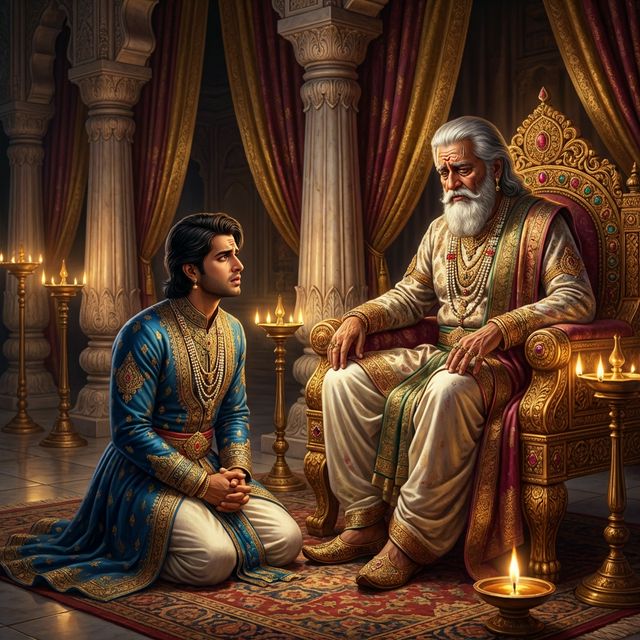
The Bed of Arrows
The camp at Kurukshetra had grown quiet with evening, and the small fires of the Pandava host were being lit one by one across the plain when Yudhishthira came again to sit at Bhishma's side. He had spent the day among petitioners, farmers and widows and men who had lost everything in the war, and more than one of them had asked him, with the particular bitterness of the desperate, why the gods let a good man's prayers go unanswered while a wicked man prospered without asking for anything at all. He put the question to his grandfather plainly. Does devotion ever go answered, he asked, in a shape the devotee cannot recognize as an answer at all?
Bhishma's laugh, when it came, was faint and dry, more breath than sound, but Yudhishthira had learned by now to listen for it, since it meant a story was coming that Bhishma found, in some private way, quietly amusing. Nearly every prayer is answered in a shape its owner cannot recognize, he said. That is very often the whole of the joke hidden inside devotion. Let me tell you of a poor man who prayed to a cloud, and of the cloud spirit who heard him, a being named Kundadhara, and of the strange thing that passed between them, which neither the man nor, for a long while, the man's neighbors, understood to be wealth at all. It is, I think, my favorite kind of story, for it turns out to have no villain in it whatsoever, only a spirit doing his honest best with limits even a god must respect.
The Poor Man's Devotion
There lived, in a certain province, a man of no particular family and less particular fortune, who owned a single field too thin to feed him through every season and a house with more gaps in its thatch than thatch. He was, by every account that survives him, an honest and gentle man, quick to share what little he had and slow to complain of what he lacked, and it was this very evenness of temper that made his poverty seem, to those who knew him, a kind of standing injustice.
He had taken, in the manner of many poor men before and since, to worshiping a minor spirit of the rain clouds named Kundadhara, not out of any special theology but because the clouds passed low and close over his field each monsoon and he had grown, in the long hours of watching them for signs of rain, into something like a friendship with the shapes they made. He offered them water each morning, and a handful of grain when he had grain to spare, and he spoke to them, half in jest and half in earnest, as a man speaks to a neighbor he sees every day.
His prayer, when he finally worked up the courage to make it plain instead of leaving it implied in his daily offerings, was simple and unashamed. Grant me wealth, he said one evening, kneeling in his doorway as the clouds gathered dark over the western hills. Not for pride's sake, spirit, but because I am tired of watching my children go without, and because I believe, perhaps wrongly, that a man with more in his hands has more he can give away. He repeated this prayer, in one form or another, for the better part of twelve years, missing no morning, growing no richer, and never once growing bitter, which was, though he did not know it, the part of his devotion that traveled furthest.
Among the Spirits
Kundadhara was, among the ranks of nature's minor powers, not a being of great authority. He could gather himself into rain and rest himself into stillness, and this office he performed faithfully across a hundred provinces, but he had no granary of gold hidden behind the clouds, no treasury from which to draw a poor man's fortune, whatever poets liked to imagine of spirits who lived in the sky.
Twelve years of a good man's unbroken devotion, however, is not a small thing even to a minor power, and Kundadhara found himself, one still morning between rains, unable to simply let the prayer pass unanswered as he had let so many others pass before. He gathered his form and went among the greater spirits and lesser gods who kept the accounts of such matters, moving from court to court the way a petitioner moves from official to official, asking at each one whether wealth might be found and released toward a man he had come, in his slow cloud-patient way, to think of as something more than a supplicant.
The answer, everywhere he asked, was the same, though delivered with varying degrees of sympathy. Wealth is not given, one ancient keeper of fortune told him, not unkindly. It is earned, or inherited, or seized, or it arrives by the turning of a wheel none of us, however old, are permitted to stop and redirect by hand. Even the gods who guard treasure do not simply hand it out to whichever prayer arrives most sincerely, or the world would have long ago run out of poor men to test its scriptures on.
Kundadhara might have returned empty-handed, as spirits so often must, except that one of the keepers, seeing his evident distress on the poor man's behalf, asked him a question that changed the shape of his errand entirely. You cannot give him gold, the keeper said. But can you give him an appetite for something gold was only ever a clumsy way of reaching toward? Can you incline his heart further into dharma than it already leans? That, spirit, is within your gift, if you have the courage to give a man something other than what he asked you for.
The Waking
The poor man woke the next morning to no chest of gold beside his sleeping mat, no sudden softness in the thatch roof he had cursed through every monsoon, no difference at all that he could see in the thin grey light of his single room. What he felt, rather than saw, took him the better part of the day to notice and the better part of a week to understand.
Where he had once thought first, on waking, of the field's yield and the debts still owed on it, he found himself thinking instead of a small act of restraint he might practice that day, a fast half-kept the week before that he now wished to keep in full, a truth he had once bent slightly in the marketplace that now sat in him like a stone he wanted out. He did not choose this shift in appetite any more than a man chooses to be hungry. He simply woke, morning after morning, wanting merit the way he had once wanted gold, with the same steady, uncomplicated hunger.
His neighbors, watching him take up one austerity after another over the following seasons, decided among themselves that poverty had finally turned his mind, and some pitied him for it while others laughed behind their hands, for those same neighbors were, in those very years, growing modestly prosperous through trade routes newly opened through the province, and measured a man's sense chiefly by the weight of his purse. He let them laugh. He fasted when he had once merely gone hungry from want, and found the fasting had a different taste entirely. He gave away the little he had left over, and found that the giving, unlike every gift he had ever received, never once left him poorer than before.
Within a decade he was known through three provinces not as a poor farmer but as a man of unusual insight, sought out by travelers who had heard, through the slow relay of such stories, that a sage lived on a thin field near the western hills who had somehow grown wealthy in a coin no drought could touch and no thief could carry off.
The Size of the Boon
The neighbors who had laughed did not, on the whole, laugh forever. Trade routes that had made three families rich in a single generation ran dry in the next, when a war two kingdoms distant closed the roads their fortunes depended on; a flood took one man's granary entire in a single night; and one of the wealthiest, grown careless in the way wealth often makes men careless, lost the whole of his fortune to a nephew's fraud and lived out his last years as a guest in houses poorer than the one he had once owned.
The poor man's boon, meanwhile, had never once been touched by flood, fraud, war, or the turning of a market, because it was not the kind of wealth that could be carried off, and it had gone on quietly compounding, as such wealth does, across every year of practice that added to the year before it, until by the time he was an old man the province counted him among its treasures rather than its unfortunates.
Bhishma stopped there, and Yudhishthira, waiting for the moral he assumed must follow, found that his grandfather seemed content to let the story simply sit. Do you see the joke in it, Bhishma asked finally. He prayed with his whole heart for gold, twelve years running, and never once received a single coin of it. And yet I do not think, if you asked him at the end of his life, that he would call his prayer unanswered. Some gifts arrive wearing the shape of a refusal, Yudhishthira, and a man who has not learned to look twice at what he is given will spend his whole life resenting the cloud that loved him enough to give him something better than what he asked for.
Dharma Lesson
Some prayers are answered by being refused, when the god who hears them sees more clearly than the one who prays. An inclination toward dharma, once planted, compounds silently across years the way wealth never can, while gold gathered without virtue scatters as easily as it came. The truest gift sometimes wears the shape of an empty hand.