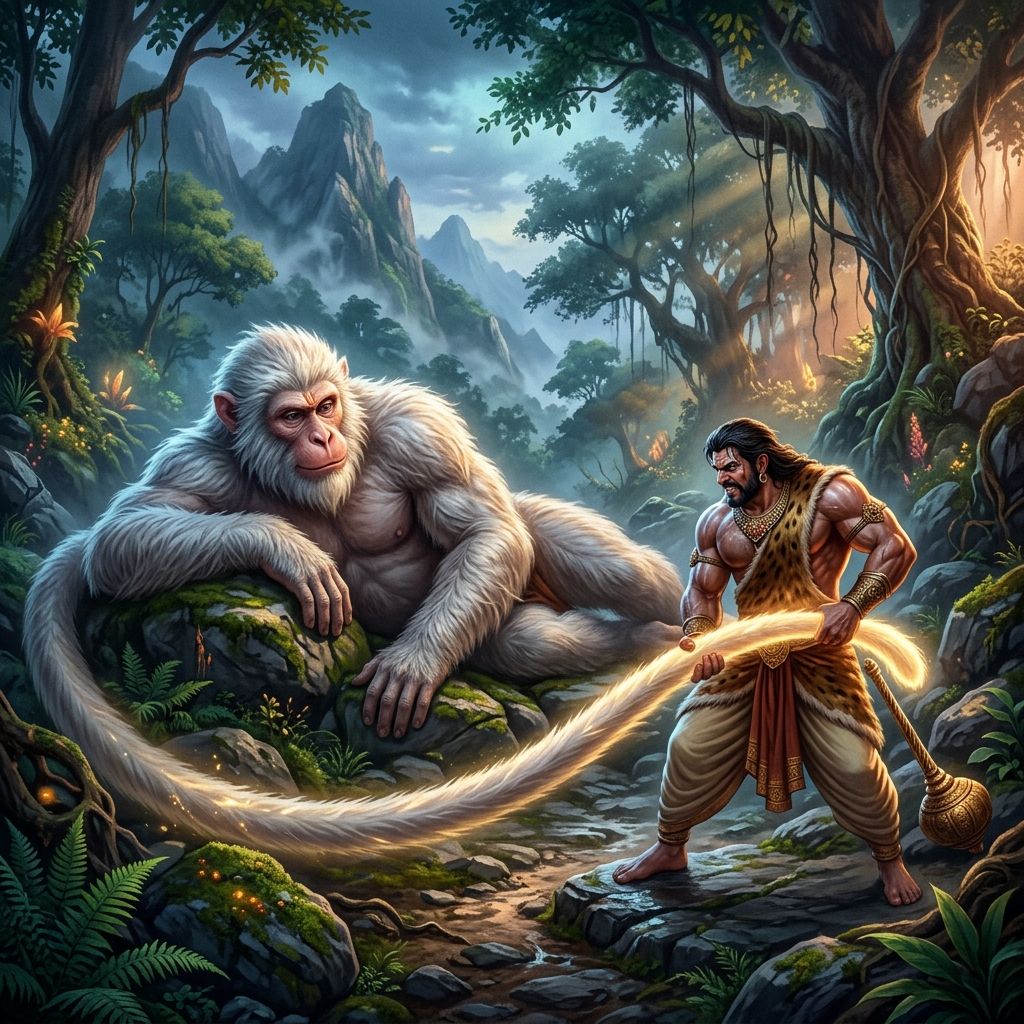
The Camp Above Badarikashrama
The forest years had carried the Pandavas higher than any road went. Arjuna was still in his father's heaven learning weapons, and the rest of the household had come north to wait for him. The last of the passes they had not walked at all; Ghatotkacha and his people had carried them over on their shoulders and set them down at Badarikashrama, where the jujube trees grow and the hot springs steam under snow and the white shoulder of Gandhamadana stands above everything.
It was a strange kind of poverty. They had no kingdom, no roof and no season they could count on, but they had a mountain, and hermits who shared their fruit, and long clear evenings in which nobody wanted anything from a king.
Into that camp, one morning, walked a brahmin.
He came up the path as though he had walked it all his life, and he greeted Yudhishthira by his full lineage without being told it. He was thin. He carried a staff and a water pot and nothing else. He asked, politely, whether the sons of Pandu minded a stranger sitting at their fire, and then he sat down at it and began, unprompted, to recite.
He recited well. That was the first thing that disarmed them. He knew every hymn that Dhaumya knew and three that Dhaumya did not, and he could argue a fine point about the proper seasons of sacrifice and then laugh at his own argument before anybody else could.
'Stay,' said Yudhishthira. 'We have little, but nobody comes up this mountain by accident.'
'I ask for nothing,' the brahmin said.
Draupadi, who had learned in twelve years to hear what people wanted before they said it, looked up at that. She heard nothing underneath it at all. She decided, that morning, that she had grown suspicious in the forest, and that a suspicious woman is no better than a foolish one.
The Guest Who Asked for Nothing
Months went by in the way that mountain months do, which is to say that they did not seem to go by at all.
The brahmin stayed. He ate what was put in front of him and praised it. He carried water when the twins carried water. He sat at the edge of the fire when the sages came down from the hermitage to talk, and he never spoke first, and when he did speak it was to loosen the knot in somebody else's argument rather than to tie one of his own. When Yudhishthira was low he told stories about kings who had waited longer. When Draupadi was sharp with grief he neither flinched nor soothed her, which she preferred.
And he asked for nothing. Not a cow, not a coin, not a word to a king on his behalf when the exile ended. In twelve years of forest the household had learned every kind of visitor: the ones who came to see how far the mighty had fallen, the ones who came for a blessing, the ones who came for a share of the vessel Surya had given Draupadi. This one came with an empty hand and kept it empty, and the camp loved him for it.
So they trusted him with the weapons.
That is the part nobody in the story defends afterwards. When the brothers went down the slope the bows went into the guest's keeping, because a brahmin who wanted nothing could not possibly want those. Nakula showed him how the strings were wrapped against the damp.
This was not Hidimba, who had smelled men in his forest and sent his sister out to fetch them. It was not Kirmira, who had come at them out of the dark of the Kamyaka road roaring that he was Baka's brother and had a debt to collect. Those two had announced themselves. Those two had been rakshasas at the top of their voices, and Bhima had answered them in the only language they had offered.
This one had studied. He had worked out that a household on a mountain, with one strong man in it, has exactly one unguarded hour, and he had spent a season finding it.
His name was Jatasura.
The Hour Bhima Hunted Alone
The hour came on an ordinary morning.
Bhima went down the ridge after deer, because the brahmins of the camp had been eating fruit for a week and Yudhishthira would not let a guest of his eat worse than he did himself. He went alone. He went a long way, which he had done a hundred times before without anything happening.
Behind him the camp was five people and a fire: Yudhishthira, the twins, Draupadi and the guest.
The guest stood up.
The change did not take him long. What had been a thin man with a water pot came up out of itself and kept coming, until his shadow lay all the way across the clearing and the fire looked like a spark in a cave. He took the bows first, and the quivers with them, sweeping them into one arm the way a man gathers kindling. Then he turned around.
'You have fed me for months,' Jatasura said. 'It was very good.'
'Put down the weapons,' said Yudhishthira.
The rakshasa laughed, and reached, and took all four of them together: the king in one hand with Draupadi caught in the crook of the same arm, Nakula and Sahadeva swept up in the other, and none of it cost him more effort than lifting a bundle of reeds. Then he ran.
He ran downhill and off the path, the way a creature runs that has measured the ground beforehand and knows which stones will hold. Draupadi shouted once for Bhima and the wind took it off the ridge and lost it. Behind them the fire went on burning with nobody sitting at it, and when the sages came down from the hermitage later that morning they found the pots still warm and the camp empty and a road of broken scrub going away down the mountain.
The King Argues While He Is Carried
What happened on that run is the reason the episode is remembered at all.
Yudhishthira, upside down in a rakshasa's fist, being carried at speed down a mountain he could not see, began to argue.
'You have eaten our food,' he said. 'You have slept inside the light of our fire. Whatever else you are, you were a guest, and a guest who lifts his hand against the house that fed him has already lost more than we have.'
Jatasura ran.
'Consider what you are carrying,' the king said. 'You are not carrying four people. You are carrying the one thing that will bring Bhima down this mountain behind you. You have my brothers' weapons on your shoulder and you are running with the reason he will not stop.'
Jatasura ran.
'And consider dharma, which is standing over you whether you look up at it or not,' Yudhishthira said. 'The world does not hold together because men are strong. It holds because a man who is given food does not turn and eat the giver. Put us down and go, and you will only have been a thief. Carry us further and you will have broken the one law that even rakshasas keep.'
Draupadi said, in a voice that carried better than his, 'He is telling you the truth, and you will not believe it until it is standing in front of you.'
None of it slowed him. But that was not entirely the point. Yudhishthira was talking because talking is what a king has left when his hands are pinned, and because every sentence bought a little more of the mountain.
And underneath the noise of it, Sahadeva was working.
He had been swept up sideways, one arm crushed against the rakshasa's ribs and the other very nearly free, and he still had a sword on him. He got the wrist loose a finger's width at a time, without a sound, while his eldest brother lectured on the duties of hospitality at the top of his voice. Then the sword came out.
'Sahadeva,' shouted Nakula, and Sahadeva cut, and the arm that held him opened, and the youngest of them came down on his feet on the stones and was already turning to face the thing when the shouting began on the ridge above.
The Ridge
Bhima had come back up to the camp with a deer across his shoulder, and he dropped it where he stood.
He did not need to track anything. A creature that size running downhill leaves a road behind it. He went after them the way water goes down a mountain, and he caught them on the open shoulder of the slope where the trees give out, and the first Jatasura knew of it was Bhima's voice at his back.
'Put them down.'
The rakshasa put them down. He had nothing else left to do; a demon carrying four people cannot fight, and he had come too far to drop them and run.
'You ate at my brother's fire,' Bhima said. 'You sat in front of my wife. You waited for the one morning I went out alone. There is no word for what you are that I have the patience to say, so we will do this the short way.'
They fought first the way strong things fight on a mountain, with whatever came to hand: rock, tree, the loose slabs of the slope. Jatasura was enormous and he was not a coward, and for a while the ground went out from under both of them and the noise came back off the snowfields above. Then Bhima put the weapons aside. He had decided how this one was going to end.
He took him in his arms, broke the grip that came around his chest, lifted the rakshasa clear of the stones and whirled him until the world was gone out of him, and brought him down across his knee, and finished it with his hands.
Yudhishthira came and stood over the body with his brothers and said nothing for a while.
'Kirmira roared at us,' he said at last. 'Hidimba sent his sister ahead. This one asked us for nothing for half a year.'
'That was the trick,' said Bhima.
'That was the whole of it,' said the king. 'A man who wants something from you has told you where he is standing. Watch the one who wants nothing. He is not being holy. He is waiting.'
Dharma Lesson
Hospitality binds both ways, and it is the guest's side of the bond that is easiest to counterfeit. Jatasura bought half a year of trust by never asking for anything, because a request tells you what a man wants and silence tells you nothing at all. Yudhishthira does not abandon the law even while being carried off by a creature breaking it, and he is right not to, because dharma does not become false when it is disobeyed. But the household still learned, at the cost of one morning, that generosity has to keep its eyes open.