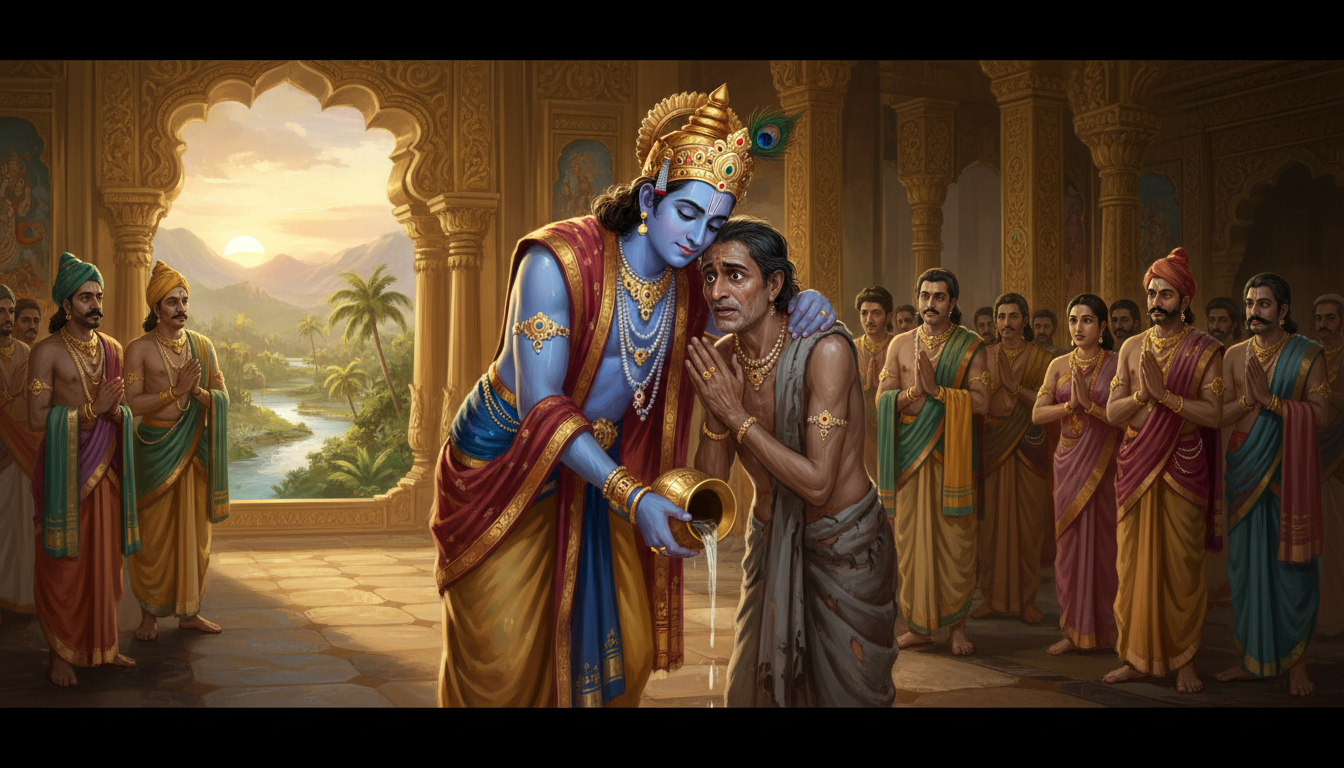
Bhagavad Gita Chapter 8, Verses 15-28: Cosmic Time and the Two Paths
Days of Brahma, bright road and dark
Every World Returns
Krishna had been speaking about the last thought of a dying man. Now, without warning, he widens the frame until the whole battlefield with its eighteen armies looks like a detail.
In verse 8.15 he says that the great souls who reach him do not take rebirth in this impermanent house of sorrow, having attained the highest perfection. The words for the world are duhkhalayam asasvatam - a dwelling place of sorrow, and impermanent. The second charge is the sharper of the two. Sorrow can be endured. What cannot be arranged around is the fact that nothing built here stays built.
Then verse 8.16, which is the verse that does the real work: a brahma-bhuvanat lokah punar avartino 'rjuna. Up to and including the world of Brahma, all worlds return.
This is aimed directly at what a warrior on that field would have been taught to want. The tradition Arjuna grew up inside had a whole architecture of heavens, and the fastest road to the best of them was to die facing the enemy. Krishna does not deny that the heavens exist. He concedes them and then quietly relativises them. Merit buys a long stay in a pleasant world, and the stay is genuinely long and genuinely pleasant, and it ends. When the merit that purchased it is used up, the resident comes back down into a body, into a fresh set of parents and appetites and fears, with nothing carried forward but the tendencies he has practised.
Even Brahma, the creator seated at the top of the ladder, is on a clock. That is the point of naming him. If the highest station in the cosmos is temporary, then no station in the cosmos is what Arjuna should be aiming at.
Only one thing is excepted. Having come to me, Krishna says, there is no rebirth.
A Day and a Night of Brahma
Verse 8.17 supplies the measurement, and it is meant to be felt rather than merely noted. Those who know the day of Brahma know it to end only after a thousand ages, and his night likewise ends after a thousand ages. Sahasra-yuga-paryantam ahar yad brahmano viduh.
A yuga is already a span no human memory reaches across. A thousand of them make one daylight for the creator, and another thousand make one night, and the creator himself lives out a full lifetime of such days. Krishna offers no comforting scaling-down. He simply lets the number stand next to the eighteen days of fighting that are about to begin.
Verse 8.18 describes what happens at each end of that day. At the coming of daybreak, all manifest things stream out from the unmanifest; at the coming of nightfall they dissolve back into that same unmanifest. The image is respiratory rather than mechanical. Creation is not a single event in the distant past but an exhalation that has happened uncountable times and will happen again.
Then verse 8.19, which is the one that stings. Bhuta-gramah sa evayam bhutva bhutva praliyate. This same multitude of beings, coming into existence again and again, dissolves helplessly at the coming of night and streams forth again at the coming of day. The word is avasah - helpless, without control, not consulted.
That single word is doing something specific to Arjuna. He has spent the morning agonising over whether he will be the one who destroys his family, as though the destruction were his to authorise. Krishna sets the entire host of beings, including every man on that plain and every ancestor whose line Arjuna is afraid of ending, inside a rhythm that has swallowed them countless times already without asking permission. The dying is not being minimised. It is being placed.
Beyond the Unmanifest
Having made the cycle enormous, Krishna now names something outside it.
Verse 8.20: paras tasmat tu bhavo 'nyo 'vyakto 'vyaktat sanatanah. Higher than that unmanifest is another unmanifest, eternal, which does not perish when all beings perish. The phrasing is careful and easy to misread. The unmanifest of verse 8.18, the reservoir into which beings dissolve at nightfall, is still part of the machinery; it is the sleeping phase of the same world. What Krishna points to now lies beyond even that, untouched when the whole apparatus of manifest and unmanifest goes down together.
Verse 8.21 gives it names. That unmanifest is called akshara, the imperishable; it is spoken of as the paramam gatim, the supreme goal; and having reached it, they do not return. That is my highest abode, Krishna says - tad dhama paramam mama.
The logic of the section now closes. Every destination that can be earned can be exhausted, so the only destination worth the trouble is the one that cannot be earned in that transactional sense at all.
Which is what makes verse 8.22 startling in its simplicity. That supreme person, in whom all beings abide and by whom all this is stretched out, is attainable - bhaktya labhyas tv ananyaya - by undivided devotion, and by nothing else named here.
After a thousand ages, after the arithmetic of days and nights that no human lifetime can span, the means turns out not to be astronomy, or merit accumulation, or the correct timing of one's death. It is ananya bhakti, devotion that is not divided among several objects. The scale of the cosmos has been laid out at length precisely so that the smallness and ordinariness of the method registers. Nothing in the machinery has to be mastered. The one thing asked for is undivided attention, and that is available to a man standing in a chariot with the fighting about to start.
The Bright Road and the Dark
Verses 8.23 to 8.26 set out one of the oldest pieces of inherited teaching in the Gita, and Krishna presents it as tradition rather than as his own invention.
In verse 8.23 he announces the subject: the times of departure at which yogis go forth never to return, and those at which they go forth and come back.
Verse 8.24 lists the first road. Fire, light, daytime, the bright fortnight of the waxing moon, the six months of the northern course of the sun - agnir jyotir ahah suklah san-masa uttarayanam. Those who depart by these, and who know Brahman, go to Brahman.
Verse 8.25 lists the second. Smoke, night, the dark fortnight of the waning moon, the six months of the southern course - dhumo ratris tatha krishnah san-masa dakshinayanam. The yogi who departs by these attains the light of the moon and returns.
Verse 8.26 sums them up. Sukla-krishne gati hy ete jagatah sasvate mate. These two paths of the world, the bright and the dark, are held to be eternal; by the one a man goes to no-return, by the other he comes back again.
Read literally, this is a calendar, and later tradition made much of it. Bhishma is about to lie on his bed of arrows for weeks, refusing to die until the sun turns north, and the reader who knows what is coming will hear that decision anticipated here.
Read as the commentators generally read it, the two roads are not dates but conditions. The bright road is made of fire, light and day, which are the standing images for knowledge; the dark road is made of smoke, which is what a fire produces when it burns badly, and of night, which is the standing image for a mind that never became clear. What a man departs through is what he has become. The calendar is the outward face of an inward state.
Confused by Neither
Then Krishna does something unexpected with the doctrine he has just recited.
Verse 8.27: naite sriti partha janan yogi muhyati kascana. Knowing these two paths, no yogi is deluded by either of them. Therefore, at all times, be established in yoga - tasmat sarvesu kalesu yoga-yukto bhavarjuna.
The refrain is the same one from verse 8.7, sarvesu kalesu, at all times, and the repetition is the point. Having laid out an elaborate scheme of auspicious and inauspicious hours, Krishna refuses to let Arjuna use it as a schedule. A man who spends his life watching the calendar for a favourable exit has divided his attention, which is exactly the failure the whole chapter has been diagnosing. The yogi is not confused by the two roads because he is not trying to time them. He is steady in all seasons, and so the season he happens to die in has nothing left to decide.
Verse 8.28 closes the chapter with a comparison that would have startled the priests. Whatever merit is assigned to study of the Vedas, to sacrifices, to austerities and to gifts, the yogi who knows all this passes beyond it, and reaches the primal supreme abode. The entire economy of ritual reward, painstakingly built over centuries, is not condemned. It is simply exceeded.
For a reader today, the eighth chapter's ending offers something more bracing than consolation. It does not say that a human life is small, though it does say that a thousand ages make one day for the creator. It says that permanence is being looked for in places that cannot supply it - in reputation, in lineage, in the pleasant worlds a good record might buy - and that the search will keep returning empty because those worlds are on the same clock as everything else. What is asked in return is not withdrawal from any of it. It is only that a person be steady in all seasons, so that no particular hour, including the last one, has to carry more weight than it can hold.
Dharma Lesson
Krishna answers a soldier's fear of death by widening the frame until a lifetime, a dynasty and an entire heaven all look brief. The point is not that nothing matters, but that permanence is being sought in the wrong places, since every world that can be earned can also be used up. What the section finally asks for is not calculation about the hour of departure but steadiness at all times.