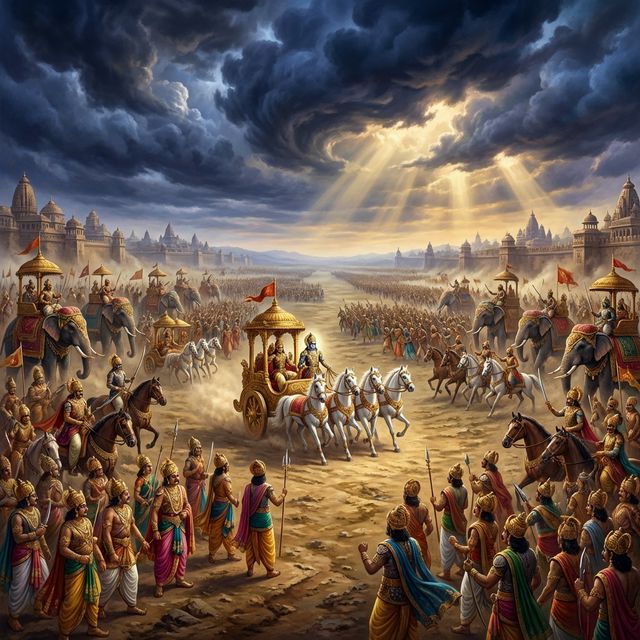
The King Who Went In Alone
Duryodhana charges the whole Pandava army by himself, and Yudhishthira cuts his bow
The Question in the Hall
Sanjaya had just finished telling the blind king how Satyaki broke Dushasana's car to pieces and went on after Arjuna, and Dhritarashtra could not let it pass.
"Were there, O Sanjaya, no mighty car-warriors in that army of mine who could slay or resist that Satyaki while he proceeded? Of prowess incapable of being baffled, and endued with might equal to that of Sakra himself, alone he achieved feats in battle like the great Indra amidst the Danavas."
Then the suspicion that had been growing in him all evening came out.
"Or, perhaps, the track by which Satyaki proceeded was empty?"
It is the question of a man who cannot see the field and has begun to wonder whether the reports he is being given are honest. His army was the larger army. It had Drona at its head. One chariot had gone through it lengthwise that afternoon and come out the other side, and if that was possible, then either the man on the chariot was more than a man or the army had not been standing where it was supposed to stand.
"Alas, possessed of true prowess, alone he hath crushed numberless warriors. Tell me, O Sanjaya, how the grandson of Sini, alone as he was, passed through that vast force struggling with him in battle?"
It was the fourteenth day of the war. Drona had drawn up the host that morning to keep Arjuna away from Jayadratha until the sun went down, and Arjuna had gone into it, and Satyaki had been sent after Arjuna, and now the day was wearing on toward its close somewhere out on the plain while the two of them sat in a hall in Hastinapura, one talking and one listening.
Sanjaya did not answer the question directly. He began, instead, by describing the size of the thing his master was asking about.
The Last Muster on Earth
"O king, the fierce exertions and the uproar made by thy host which abounded with cars and elephants and steeds and foot-soldiers resembled what is seen at the end of the yuga."
Sanjaya had been watching that army form up every morning for a fortnight, and he had formed an opinion about it which he now gave.
"O giver of honours, when thy assembled host was daily mustered, it seemed to me that another assemblage like that of thy army had never been on earth."
He was not the only one who thought so. There were others on that field who were qualified to judge, having watched the world for a long time, and Sanjaya reports what they said.
"The gods and the Charanas, who came there, said, 'This muster will be the last of its kind on earth.'"
The Charanas are the wandering singers of the celestial regions, the ones whose business it is to see a great deed done and carry the account of it away. When men like that stand over a battlefield and say that nothing on this scale will ever be assembled again, it is not praise. It is an obituary being written in advance for a whole order of kings.
"Indeed, O king, never had such an array been formed before as that which was formed by Drona on the day of Jayadratha's slaughter. The uproar made by those vast bodies of soldiers rushing at one another in battle resembled that of the ocean itself lashed into fury by the tempest. In that host of thine, as also in that of the Pandavas, there were hundreds and thousands of kings, O best of men. The noise made by those angry heroes of fierce deeds while engaged in battle was tremendous and made the hair stand on end."
That was the force Satyaki had ridden through. Sanjaya let the size of it stand for a moment before he told his king what the other side had been shouting while it happened.
Come, Strike, Rush
The Pandava commanders were doing arithmetic out loud, and it was the arithmetic of men who know that two of their number are somewhere inside the enemy and cannot be reached.
Bhimasena and Dhrishtadyumna, the prince of the Panchalas who had been born to kill Drona and now held the command under Yudhishthira, and Nakula and Sahadeva and king Yudhishthira the Just, all of them shouting together, and the shout was three words long.
"Come, Strike, Rush."
Then the reason for it.
"The brave Madhava and Arjuna have entered the hostile army. Do that quickly by which they may easily go to where Jayadratha's car is."
And then, because soldiers fight better when they have been told exactly what is at stake, the commanders told them.
"If Satyaki and Arjuna be slain, Kurus will have achieved their objects, and ourselves shall be defeated. All of you, therefore, uniting together, quickly agitate this ocean-like army of the foe like impetuous winds agitating the deep."
The warriors thus urged by Bhimasena and the prince of the Panchalas smothered the Kauravas, becoming reckless of their very lives. Sanjaya, who was describing his own side's enemies to his own side's king, did not shade the description. Endued with great energy, all of them, desiring death in battle at the point or the edge of weapons in expectation of heaven, showed not the least regard for their lives in fighting for their friends.
And the Kaurava troops, he said in the same breath, stood on the field in exactly the same condition, desirous of great renown and nobly resolved upon battle, determined to fight.
In that fierce and terrible battle Satyaki, having vanquished all the combatants, proceeded towards Arjuna. That was the answer to the question the blind king had asked. The track had not been empty. It had been full, and he had gone through it anyway.
The sun by then was low and hard in the west, and the light coming off the bright armour of the warriors was so fierce that men fighting for their lives had to turn their eyes away from other men in order to go on fighting.
And into that army, at that hour, the king of the Kauravas went alone.
The King Goes In Alone
"Duryodhana also, O king, penetrated the mighty host of the high-souled Pandavas vigorously struggling in battle. The encounter that took place between him on the one side and them on the other was exceedingly fierce, and great was the carnage that occurred there on the occasion."
Sanjaya said it in one sentence and would have gone on, but his listener stopped him.
Dhritarashtra had two sons on that field who mattered to him beyond all counting, and one of them had just been described as riding into the whole Pandava army by himself. The old man's questions in this hall are usually about dharma or about omens. This one is not. It is a father's question, and it is asked twice in the same breath because he cannot make himself believe the first version.
"When the Pandava host was thus proceeding to battle, Duryodhana, in penetrating it, must have been placed in great distress. I hope he did not turn his back upon the field, O Suta."
Then he began to argue with himself about it, the way a man does when he wants to be told a thing and is preparing an excuse in case the answer goes the other way.
"That encounter between one and the many in dreadful battle, the one, again, being a king, seems to me to have been very unequal. Besides, Duryodhana hath been brought up in great luxury, in wealth and possessions. He is a king of men."
It is an unlovely thing for a father to say and a true one. This was the prince who had never in his life been made to want anything, who had been given a kingdom to hold and had held it by refusing to give five villages away, and whose whole quarrel had begun in the assurance that what he wanted was his. Nobody had ever asked him to stand somewhere unprotected.
"Alone encountering many, I hope he did not turn back from fight."
Sanjaya, who had spent fourteen days watching this king's son and had few illusions about him, gave the honest answer.
"Listen to me, O king, as I describe, O Bharata, that wonderful battle fought by thy son, that encounter between one and the many."
The Elephant in the Lotus Lake
"Indeed, the Pandava army was agitated by Duryodhana in that battle, like an assemblage of lotus-stalks in a lake by an elephant."
It is a strange image to use for a battle, and it is exact. The stalks are not cut. They are simply lifted and pushed and set swaying in every direction, and the water goes cloudy, and the surface of the lake stops being a surface, and one animal has done all of it by walking in.
Seeing the army thus smitten by him, the Panchalas headed by Bhimasena rushed at the place where he was.
What follows is a tally, and Sanjaya gives it the way a man gives evidence, arrow by arrow, because he is answering a question about whether a king turned his back.
Duryodhana pierced Bhimasena with ten arrows.
Each of the twins, Nakula and Sahadeva, with three.
King Yudhishthira with seven.
Virata and Drupada with six apiece, the two old kings whose houses had sheltered and fathered the Pandava cause, standing side by side in the line as they had all that fortnight.
Shikhandi with a hundred, and the hundred says something about the man shooting them, since Shikhandi was the one who had stood in front of Bhishma on the tenth day and brought him down, and Duryodhana had not forgotten it.
Dhrishtadyumna, the commander of the whole army opposite him, with twenty.
And each of the five sons of Draupadi with three.
That is nine of the great car-warriors of the Pandava host, its king, its commander, its two royal fathers-in-law, and the boys, all of them wounded inside the space of a few minutes by one man who had come in without support and had not yet been touched.
And around them, with his fierce shafts, he cut off hundreds of other combatants in that battle, including elephants and car-warriors, like the Destroyer himself in wrath exterminating creatures.
Nobody on that field, on either side, had expected this from him.
The Bow Drawn Into a Circle
Sanjaya stops the account at this point to explain how it was being done, and the explanation is worth attending to, because it is the only place in the whole epic where anyone bothers to say what Duryodhana was good at.
"In consequence of his skill cultured by practice, and of the power of his weapons, he seemed, as he was engaged in striking down his foes, to bend his bow incessantly drawn to a circle whether when aiming or letting off his shafts."
Skill cultured by practice. Not a boon, not an astra begged from a god, not a celestial weapon that answers to a mantra. The man had been the pupil of the same teacher as Arjuna, and he had put in the years, and on this one afternoon the years showed.
"Indeed, that formidable bow of his, the back of whose staff was decked with gold, was seen by people to be drawn into a perpetual circle as he was employed in slaying his enemies."
People saw it. That is Sanjaya's phrase, and it means the fighting near him had slowed enough for men to look. A bow that is being drawn and released at speed is a thing that opens and shuts. This one never shut. Whether he was taking aim or loosing, the gold-backed staff stood bent into the same full circle, and from a little distance you could not tell the shots apart or count them, and the arrows simply came.
The Panchalas had been sent to stop one chariot. What they had run into was a man who did not seem to be reloading.
It lasted as long as such things last. Somewhere on the far side of the field Arjuna was still going toward Jayadratha and the sun was still going down, and here, at the point where the Pandava line had bent inward around a single car, the eldest son of Dhritarashtra was holding the whole Pandava host by himself and the noise of it had begun to carry.
Then the Pandava king came forward against him.
Wait, Wait
Yudhishthira took a couple of broad-headed shafts and cut the bow off in Duryodhana's hands as he struggled in the fight.
Then he pierced him deeply with ten excellent and foremost of shafts, aimed at the body, and this is the eldest Pandava, who is not the archer of the family and is not supposed to be able to do such a thing to such a man.
The arrows reached him and did nothing. Touching the armour of Duryodhana, they quickly broke into pieces.
But the bow was gone, and for a moment there was a disarmed king standing in the middle of an army that wanted him dead, and the Parthas, filled with delight, surrounded Yudhishthira, like the celestials and great Rishis in days of old surrounding Sakra on the occasion of the slaughter of Vritra.
It is the largest compliment the poem knows how to pay, and it was paid for a bow cut in half. That is how badly they had wanted this particular man in front of them, and how long they had waited.
The delight lasted no longer than it took Duryodhana to reach behind him and pick up another bow.
He strung it, and he did not withdraw, and he did not go looking for his own lines. He turned his car at the king who had just disarmed him and called out to him across the noise.
"Wait. Wait."
And he rushed against him.
The Panchalas came forward to receive him cheerfully and with hopes of victory, and would have had him, and did not, because Drona, desirous of rescuing the Kuru king, arrived across their path and took them the way a mountain receives masses of rain-charged clouds driven by tempest.
So the battle was three battles by the end. Drona holding the gate of his own array against the Panchalas. Satyaki fighting through the middle of the Kaurava host. And somewhere beyond both of them a loud uproar rose at the place where Arjuna was, and that uproar, making the hair stand on end, rose above all other sounds on the field.
Dhritarashtra had asked whether his son turned his back. He had not. It is the one thing nobody on that field could ever say of him, and it did not save a single man alive.
Dharma Lesson
Sanjaya has no reason to flatter Duryodhana and flatters him here anyway, because the truth of that hour was that the king did not turn his back. Courage is not the same thing as being right, and the poem refuses to let us confuse them: the man holding a whole army by himself is the same man whose covetousness put both armies on that field. What Sanjaya credits him with is not a boon or a celestial weapon but skill cultured by practice, the one virtue Duryodhana earned honestly. It bought him a few minutes of glory and cost everyone else everything.