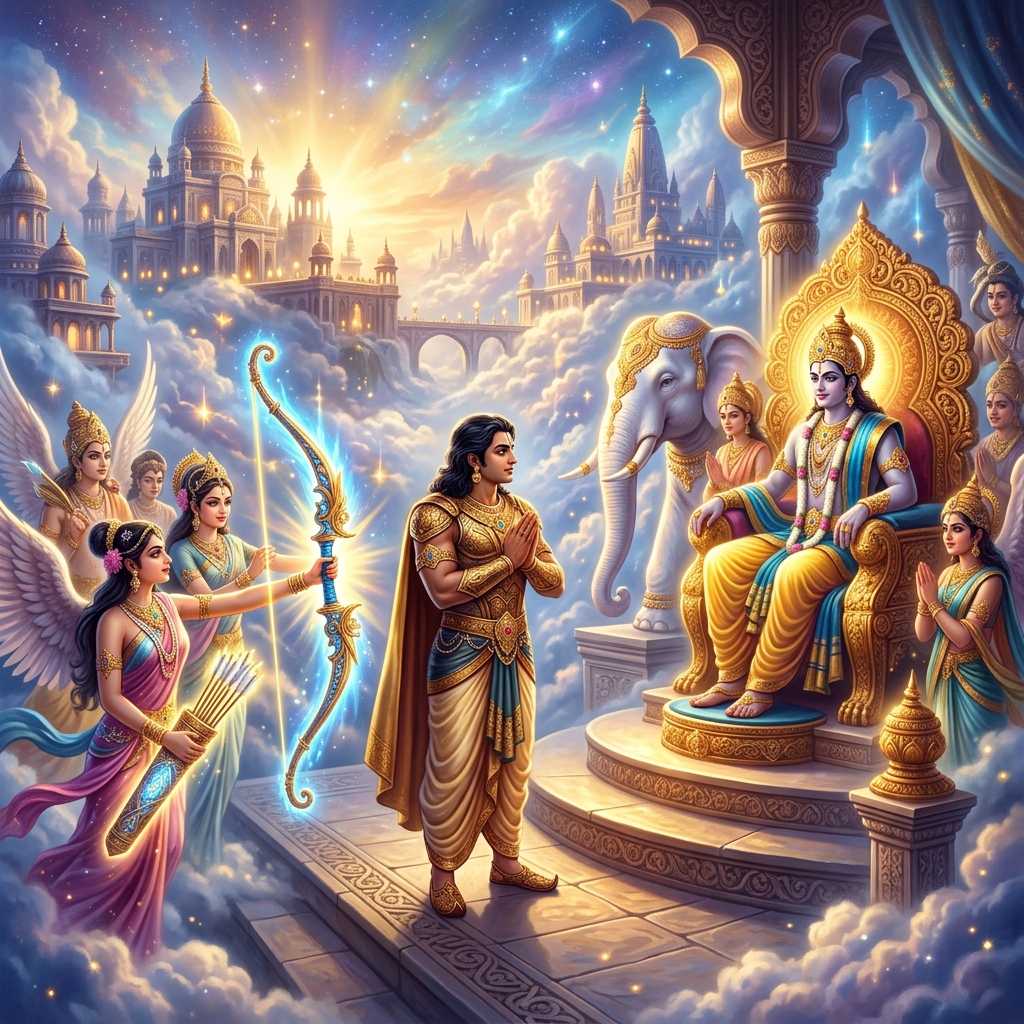
The Strangest Pupil in Amaravati
In the heavenly city of Amaravati, where Indra held court amid gardens that never wilted and music that never stopped, Chitrasena ruled a smaller and stranger kingdom of his own: the arts of song, dance, and the disciplined grace that heaven considered as serious a study as any weapon. He was the finest of the gandharvas, teacher to apsaras and gods alike, and he had never in all his years of instruction met a pupil like the one Indra sent him.
Arjuna had come to Amaravati to learn the use of celestial weapons, summoned by his own father Indra to receive the divine arms he would need in the war to come. That much the court expected. What surprised Chitrasena was the second half of Indra's instruction: that this same warrior, whose bow had already humbled gods and men, should also sit at Chitrasena's feet and learn to sing, to dance, and to keep rhythm and grace in a body built entirely for the drawing of a bow.
Arjuna did not resist the assignment, though he might have. He came to Chitrasena's practice hall each day with the same unbroken discipline he brought to his archery, and Chitrasena, watching him fumble through his first uncertain steps, found himself amused, then curious, then genuinely fond of this earnest, overserious man who treated a dance lesson with the gravity of a duel.
"Why does a warrior need this?" Arjuna asked him once, not in complaint but honest puzzlement.
Chitrasena only smiled, the smile of someone who had watched centuries of gods and heroes ask the same question. "Because the hand that can only strike," he said, "is only half a hand. Wait, and you will understand why your father asked this of you before you understand why he armed you." Arjuna did not understand yet. He would.
The Craft That Would Save Them
Five years passed in Amaravati, though time moved differently there than on earth, and in those years an unlikely friendship grew between the gandharva master and his human student. Chitrasena taught Arjuna the disciplines of song and dance not as decoration but as craft, with the same rigor any archery master would bring to the bow: the precise counts of rhythm, the exact language of gesture, the breath control that let a dancer hold a pose as steadily as an archer holds a draw.
Arjuna proved, as he proved at everything he set himself to, an exceptional pupil. Within those years he mastered enough of the gandharva arts that Chitrasena, watching him, sometimes forgot he was training a warrior at all rather than one of heaven's own performers. Their friendship deepened past teacher and student into something closer to equals who respected each other's very different disciplines, art and arms, and had come, through five years of daily practice, to see how little difference truly separated them.
Neither Chitrasena nor Arjuna knew, in those training years, exactly why Indra had insisted on this particular gift. The purpose revealed itself only later, when the Pandavas' exile required them to spend a final year hidden entirely from recognition, disguised among strangers in a stranger's court. It was there, at Virata's court, that Arjuna's stolen year as a music and dance teacher, drawing on nothing but what Chitrasena had given him in Amaravati, kept the world's greatest archer safely unknown behind the guise of a eunuch dance master. Chitrasena's gentle art, once dismissed by both of them as the lesser half of Arjuna's heavenly education, turned out to be the very thing that would keep his family alive.
Word from Dvaitavana
Chitrasena's business was not confined to heaven. Gandharvas moved freely between the worlds, and it was his custom, from time to time, to lead his host down to the forests of earth to camp beside some quiet lake and take their pleasure away from the endless festivity of Amaravati. In this way he came to Dvaitavana, the same forest where the exiled Pandavas had made one of their many camps, and made his own camp at its lake with his wives and companions, claiming for a season the water and the shade.
He had not come there for the Pandavas' sake, nor had he any quarrel with the Kauravas he had never met. But Duryodhana arrived at that same lake soon after, leading a great procession got up as a cattle inspection tour, and everyone in his party understood the tour's true purpose: to march his wealth and his royal retinue past his exiled cousins' humble camp and let them see exactly what they had lost. It was cruelty dressed as ordinary business, and Duryodhana meant every step of it.
When his advance men reached the lake and found it already occupied, they carried back word that gandharvas had camped there and would not yield the ground to mortal kings, however grand their procession. Duryodhana, who yielded ground to no one, sent orders for the intruders to be driven off by force.
His counselors urged caution, reminding him that gandharvas were no ordinary trespassers and that Amaravati's own hosts were not accustomed to being ordered off a lake by mortal soldiers. Duryodhana would not hear it. He had staged the whole expedition to humble his exiled cousins in front of witnesses, and he was not about to let a band of heavenly musicians spoil the display he had planned so carefully. He sent his warriors forward with instructions to clear the shore before nightfall, certain that whatever resistance a company of singers and dancers could offer would break at the first serious charge.
The Rout at the Lake
Duryodhana's warriors advanced on the lake expecting the easy work of clearing squatters from royal ground. Chitrasena's gandharvas were not squatters. They were heaven's own host, and when the Kauravas' arrows began to fly, the gandharvas answered with a violence that made it plain within minutes how badly the mortal army had misjudged its opponents.
Chitrasena led the counterattack himself, and under his command the gandharva host broke Duryodhana's army as thoroughly as any human general has ever been broken. The Kaurava brothers who had come to gloat over exiled cousins were scattered, unhorsed, humiliated in exactly the manner they had intended to visit on the Pandavas. Duryodhana himself was seized and bound along with his queen, dragged before Chitrasena as a captive rather than the conquering visitor he had ridden out to be.
Word of the disaster reached the Pandavas' own camp before the gandharvas had finished securing their prisoners, and Yudhishthira, hearing that his cousin lay bound at the mercy of a heavenly army, did the thing his enemies would never have predicted and never quite understood: he ordered his brothers to go and free him.
Bhima and Arjuna argued against it, not without reason. Here was the man who had cheated them at dice, exiled them, insulted Draupadi, and now arrived at their own refuge to flaunt his fortune in their faces, delivered bound into their hands by forces entirely outside their own doing. Yudhishthira would not be moved. A kinsman's humiliation before strangers, he said, however deserved it might feel, was a shame that fell on the whole Kuru line, Pandava included. Arjuna went to the gandharva camp to ask for his cousin's release.
An Argument With Heaven's Justice
Chitrasena received his old student with open pleasure, embracing him as the friend five years in Amaravati had made him, and heard out Arjuna's request with real reluctance. He did not want to give Duryodhana up.
"I did not seize your cousin out of malice toward your house," he told Arjuna. "I seized him because Indra himself, watching from above, saw a king abuse the very dharma of hospitality with cruelty toward exiled kin, and gave me leave to answer it. This capture is heaven's warrant, not a private grudge of mine. Why should I release a man heaven itself judged worth binding?"
Arjuna pressed him anyway, not on the justice of the capture but on what came after it. Whatever Duryodhana deserved, he said, it was Yudhishthira's wish that a kinsman not be humiliated before a heavenly host and dragged in chains before watching Pandavas who had themselves once been made to walk in shame. That indignity would shadow the whole family, victors included, long after the satisfaction of it faded.
Chitrasena weighed his own certainty against his old friend's request, and in the end it was the friendship, more than the argument, that moved him. He released Duryodhana and his queen unharmed, restoring what little dignity he could to a defeat that could not otherwise be undone, and departed again for Amaravati with his host, leaving the forest as quiet as he had found it.
What remained, long after gandharvas and Kauravas had both gone their ways, was the shape of the lesson itself: that Chitrasena had been entirely right to punish cruelty, and Yudhishthira had been entirely right to ask for mercy anyway, and that both things could be true at once. Art and arms, heaven's justice and human mercy, need not stand as enemies. Sometimes the finer discipline is knowing when to set a rightful claim aside.
Dharma Lesson
Even a punishment sanctioned by heaven can be softened by mercy without denying its justice. Chitrasena's friendship with Arjuna shows that the gentle arts and the arts of war are one discipline, not opposites, and that true mastery includes knowing when to yield a rightful claim. Compassion toward a kinsman, even an undeserving one, protects the dignity of the whole family.