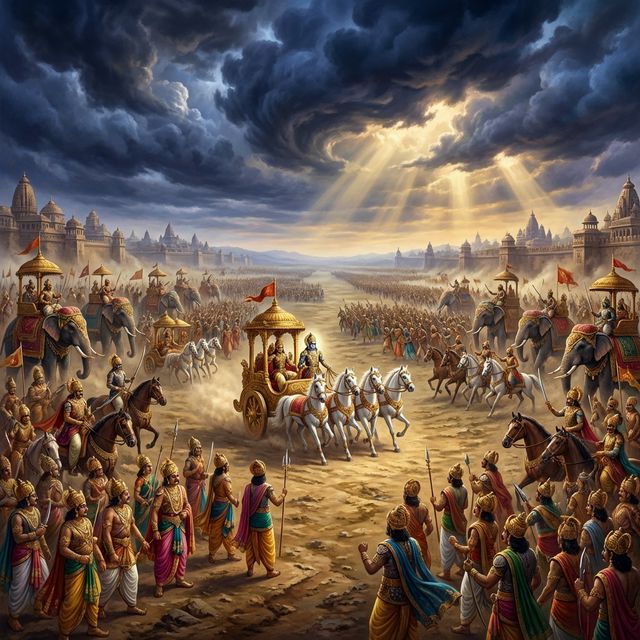
Bhrigu in Agastya's Hair
How an unseen sage cursed the mortal king of heaven into a snake
The Question About Lamps
Yudhishthira had asked about flowers and incense and lights once already, and Bhishma had answered him at length, tracing the answer back through Manu to Sukra and to Vali the Asura king, and it had not settled the matter.
The king came back to it the next morning, on the field at Kurukshetra where the old man lay on his bed of arrows with the whole surviving court sitting around him in the dust.
"I have heard, chief of the Bharatas, what the merits are that are won by presenters of flowers and incense and lights," he said. "I have heard thee speak also of the merits that attach to a due observance of the ordinances in respect of the presentation of the Vali. It behoveth thee, grandsire, to discourse unto me once more on this subject. Tell me once more of the merits of presenting incense and lights. And tell me this. Why are Valis offered on the ground by persons leading the domestic mode of life?"
It is a small question, and Bhishma did not answer it with a rule. He answered it with a story about the sovereignty of heaven.
"In this connection," he said, "is recited the old narrative of the discourse between Nahusha and Agastya and Bhrigu."
Yudhishthira knew the name in the middle of that list better than he wanted to. Nahusha was the king who had been made chief of the gods and lost the place again, and the Pandavas had met what was left of him in the forest, in the body of an enormous python that had caught Bhima in its coils and would not let go until the questions it asked were answered. Shalya had told the outline of the tale on the eve of the war.
What Bhishma was about to tell was the part nobody had told: how the mortal came down.
The King Who Kept the Rites in Heaven
"The royal sage Nahusha," said Bhishma, "possessed of wealth of penances, acquired the sovereignty of Heaven by his own good deeds."
That is the first thing to hold on to, because everything that follows depends on it. He did not seize the throne of Amaravati and he was not given it as a favour. He earned it in the only currency heaven accepts, and when he arrived there he went on doing exactly what had earned it.
With restrained senses he dwelt in heaven, and Bhishma listed his days there like a man reading an inventory. The diverse rites with respect to the sacrificial fire. The collection of sacred fuel and of kusa grass, and of flowers. The presentation of the Vali, that offering of food adorned with fried paddy reduced to powder, set down for the household deities. The offer of incense. The offer of light.
All of these, said the grandsire, occurred daily in the abode of that high-souled king while he dwelt in heaven.
There is something absurd about it if you look at it directly. Here is a man living among the gods, performing the small evening observances that a householder performs for the gods, in the house of the gods. He kept the sacrifice of japa, the silent recitation, and the sacrifice of meditation, which are the two sacrifices that need no altar and no priest and no wealth at all. And although he had become the chief of the deities, he yet worshipped all the deities, as he used to do in days of yore, with due rites and ceremonies.
He bowed to the beings he outranked. He lit lamps in the country where light comes from.
Diverse kinds of human acts and diverse kinds of celestial acts flowed from him together, and the two kinds did not quarrel in him, and for that whole first stretch of his reign there was nothing in heaven to complain of.
Then, said Bhishma, some time after, Nahusha realised his position as the chief of all the deities.
The Day He Remembered What He Was
Realising it filled him with pride.
Bhishma put the whole collapse into one sentence and did not decorate it. From that time all his acts of the kind spoken of were suspended. The fire, the fuel, the kusa grass, the flowers, the Vali on the ground, the incense, the lamp at evening. Not abolished by decree. Simply not done, by a man who had stopped seeing the point of doing them.
And what followed was not punishment. It was subtraction. In consequence of his abstention from all religious acts, his energy began to sustain a diminution. The thing he had climbed on had been the thing holding him up, and he had let go of it while standing at the top.
Filled with arrogance in consequence of the boon he had received from all the deities, Nahusha caused the very Rishis to bear him on their shoulders.
That is the sentence the whole story turns on. The rishis of the three worlds, men possessed of wealth of penances, were harnessed to the palanquin of a king who had been one of them, and made to carry him about heaven at a walk. He did not do it once in a fit of temper. He organised it. He caused the Rishis to discharge by turns his humiliating work, which means there was a roster, and a man whose turn it was, and a man whose turn was coming.
The time was very long for which he kept it up.
And while the ascetics of the universe took their turns under the poles of his car, his energy went on diminishing, because he had not offered incense or set down a lamp in years, and no one in heaven could think of a way to stop him.
Then, said Bhishma, the day came when it was Agastya's turn.
Bhrigu Comes to the Asylum
Agastya was sitting in his asylum when Bhrigu came to him.
They were not small men. Agastya was the son of Mitravaruna, the sage who had drunk the ocean dry to expose the demons hiding in it and had pressed the Vindhya mountain down and kept it down. Bhrigu was the founder of a line of Brahmanas that reached to Sukra himself, foremost of all persons conversant with Brahma, a rishi whose curses were part of the furniture of the world.
Between them they had enough power to burn a kingdom, and both of them had a turn coming on the roster of a palanquin.
Bhrigu did not soften it.
"Great ascetic," he said, "why should we patiently put up with such indignity inflicted on us by this wicked-souled Nahusha who has become the chief of the deities?"
It is the question of a man who has been thinking about it for a long time and has come to the door of the one person he believes may already have an answer. There is no plan in it yet. There is only the plain refusal to keep calling the arrangement acceptable.
And Agastya, who was about to be yoked, did not answer with anger. He answered with the reason nobody had acted, and it was a better reason than Bhrigu had expected.
"How can I succeed in cursing Nahusha, great Rishi?"
He said it as a question about method, not about will. He had considered it. Everyone had considered it. The difficulty was not that the rishis of heaven lacked the fire to burn a king. The difficulty, as Agastya was about to explain, was that the king had been to the Grandsire first, and had asked for exactly the right thing.
The Boon That Made Him Untouchable
"It is known to thee how the boon-giving Brahman himself has given Nahusha the best of boons," said Agastya.
Then he named it.
"Coming to heaven, the boon that Nahusha solicited was that whoever would come within the range of his vision would, deprived of all energy, come within his sway."
Read what he had asked for. Not invulnerability, which can be worked around, and not a weapon, which can be answered with a weapon. He had asked that anyone he could see should lose his power and fall under his control, by the fact of being looked at. A rishi standing in front of Nahusha with a curse ready in his mouth was a rishi with nothing in his mouth at all. The energy went out of him at the moment he entered the king's field of vision, and it went into the king.
"The self-born Brahman granted him even this boon," said Agastya, "and it is for that reason that neither thyself nor I have been able to consume him. Without doubt, it is for this reason that none else amongst the foremost of Rishis has been able to consume or hurl him down from his high position."
And there was a second gift on top of the first.
"Formerly, Lord, nectar was given by Brahman to Nahusha for quaffing. For that reason also we have become powerless against him."
Agastya said the next thing carefully, as a man says a thing he has turned over many times and does not entirely understand.
"The supreme deity, it seems, gave that boon to Nahusha for plunging all creatures into grief."
Then the complaint under the complaint, which is the same in every age.
"That wretch among men behaves most unrighteously towards the Brahmanas. Foremost of all speakers, do thou tell us what should be done in view of the situation. Without doubt, I shall do what thou wilt advise."
He had been asked why he put up with it. He had answered, and then he had put himself in the other man's hands.
I Have Come at the Command of the Grandsire
Bhrigu had not walked into that asylum by chance, and he said so.
"It is at the command of the Grandsire that I have come to thee," he said, "with the view of counteracting the puissance of Nahusha, who is possessed of great energy but who has been stupefied by fate."
The being who had given the boon had sent the man who would get around it. Brahma had not revoked what he granted, because what Brahma grants is not revoked. He had simply sent Bhrigu down the hill to Agastya's door.
Then Bhrigu told him what was going to happen that day, in order, before any of it had happened.
"That exceedingly wicked-souled wight who has become the chief of the deities will today yoke thee to his car. With the aid of my energy I shall today hurl him down from his position as Indra, in consequence of his having transcended all restraints. I shall today, in thy very sight, re-establish the true Indra in his position, him who has performed a hundred horse-sacrifices, having hurled the wicked-souled and sinful Nahusha from that seat."
And then the part that was not a prediction about Nahusha but a demand made of Agastya.
"That unrighteous chief of the deities will today insult thee by a kick, in consequence of his understanding being afflicted by fate and for bringing about his own downfall. Incensed at such an insult I shall today curse that sinful wretch, that enemy of the Brahmanas, that has transcended all restraints, saying, Be thou transformed into a snake. In the very sight, great ascetic, I shall today hurl down on the earth the wicked-souled Nahusha, who shall be deprived of all energy in consequence of the cries of Fie that will be uttered from all sides."
He had described a foot coming down on Agastya's head, and he had described it to Agastya's face, and then he asked permission.
"I shall do this, if it be acceptable to thee, ascetic."
Thus addressed by Bhrigu, Mitravaruna's son Agastya, of unfading puissance and glory, became highly gratified and freed from every anxiety.
He agreed to be kicked.
Close Thy Eyes
By then the throne of heaven was not what it had been.
The chief of the deities, in consequence of his abstention from observing the ordinances about the offers of incense and light, had gone on declining in energy, and his sacrificial rites and his presents were now being obstructed by Rakshasas. That is what happens to a house where the evening lamp has stopped being lit. Things get in.
It was at this time, said Bhishma, that Nahusha yoked that foremost of rishis, Agastya, to his car.
He was in a good mood about it. Endued with great strength, Nahusha, smiling the while, set the great Rishi quickly to the task, commanding him to bear the vehicle from the banks of the Saraswati to whatever place he should indicate.
And on the bank of that river, before Agastya went up to the car, Bhrigu came to him with an instruction that sounds like nothing at all.
"Do thou close thy eyes till I enter into the matted locks on thy head."
Agastya shut his eyes. This mattered. Bhrigu was about to make himself very small and very close to the one man Nahusha would certainly be looking at, and the boon worked by sight in both directions: what the king saw, the king drained. A hidden thing that has been seen entering its hiding place is not hidden.
So the eyes closed, and Bhrigu of unfading glory and mighty energy entered into the matted locks of Agastya, and Ganguli's line for the rishi at that moment is the best line in the story. Agastya stood still like a wooden post.
Not a sage gathering himself for a confrontation. A post. A thing to be harnessed, standing where it had been put, with the whole answer to the boon of Brahma folded up and waiting in its hair.
Soon after, Nahusha saw Agastya approach him for bearing his vehicle.
Yoke Me Without Delay
Agastya spoke first, and he spoke like a servant.
"Do thou yoke me to thy vehicle without delay. To what region shall I bear thee? Lord of the deities, I shall bear thee to the spot which thou mayst be pleased to direct."
There was no protest in it and no irony that Nahusha could hear. Thus addressed by him, Nahusha caused the ascetic to be yoked to his vehicle, and the pole came down on the shoulders of the man who had swallowed the sea.
Bhrigu, staying within the matted locks, became highly pleased at this act of Nahusha.
He was pleased because the king had just done the thing that would finish him, and because the arrangement was holding. And here Bhishma inserted the detail that shows how carefully the hidden man was working. He took care not to cast his eyes upon Nahusha. Fully acquainted with the energy the illustrious Nahusha had acquired in consequence of the boon which Brahman had granted him, Bhrigu conducted himself in this way.
He did not look out. He rode in the hair of a harnessed sage with his eyes turned away from the king, because the boon did not care whether you were hiding. It cared whether you looked.
Agastya, though treated in this way, did not give way to wrath. He pulled.
Then king Nahusha urged Agastya on with his goad. A goad is for cattle. The righteous-souled Rishi did not still give way to anger, and did not go faster, and this is the point at which a man in the car begins to feel that the animal is refusing him without disobeying him.
The lord of the deities, himself giving way to anger, then struck Agastya on the head with his left foot.
That is the whole of the offence. One kick, delivered by a mortal who had been given heaven for his good conduct, with the left foot, onto the head of a Brahmana, in front of a river.
Sarpa
Bhrigu, who was staying within Agastya's matted locks, became incensed.
He did not come out. He cursed from inside the hair, unseen, with his eyes still turned away from the man he was destroying.
"Since thou hast struck with thy foot on the head of this great Rishi, do thou, therefore, fall down on the earth, transformed into a snake, wretch of wicked understanding."
The word was sarpa. Snake. It is not an elaborate curse and it does not name a term of years or a condition of release. It is the shortest possible statement of what the king had made of himself: a thing that goes on its belly on the ground, which is where the Vali is set down, which is where he had stopped setting anything down.
Thus cursed by Bhrigu, who had not been seen, Nahusha immediately became transformed into a snake and fell down on the earth.
Bhishma said the next sentence to make sure the king on the field understood what had actually defeated a boon of Brahma.
"If, monarch, Nahusha had seen Bhrigu, the latter would not then have succeeded, by his energy, in hurling the former down on the earth."
The boon never failed. Nothing in the story overpowers it. It was simply never engaged, because the one man in the three worlds who could burn the king had spent the entire afternoon within arm's reach of him and had never once been looked at. The most powerful defence in heaven was defeated by the ordinary fact that a man cannot see what is in another man's hair.
And the sovereignty of the gods, which had been won by penances and lost by pride, ended on a riverbank with a shout of Fie going up from every side and a snake in the grass where a chariot had been.
It should have ended there. It did not, and the reason it did not is the reason Bhishma was telling the story at all.
The Snake That Kept Its Memory
In consequence of the various gifts that Nahusha had made, as also his penances and religious observances, though hurled down on the earth he succeeded in retaining his memory.
That is what the lamps had bought him. Everything else was gone: the throne, the boon, the nectar, the shape he was born in. The years of small evening observances he had performed before he grew too grand for them had left him one thing. He knew who he was, lying in the grass.
So he began to propitiate Bhrigu. And Agastya, whose head had been kicked an hour earlier, filled with compassion, joined him in pacifying Bhrigu for an end of the course.
At last Bhrigu felt compassion for him.
"There will appear a king on earth," he said, "of the name of Yudhishthira, the foremost of his race. He will rescue thee from this curse."
Having said this, the Rishi vanished in the very sight of Nahusha, and Agastya, having accomplished the business of the true Indra, returned to his own asylum, worshipped by all members of the regenerate order.
Bhrigu went to the region of Brahman and told the Grandsire. The Grandsire called Indra back and addressed the deities.
"Ye deities, through the boon I had granted him, Nahusha had obtained the sovereignty of heaven. Deprived of that sovereignty, he has been hurled on the earth. Ye will not succeed in living without a chief. Do ye, therefore, once more install Indra in the sovereignty of Heaven."
The deities, filled with joy, said, "So be it." Brahma installed Indra, and Vasava began once more to shine in beauty and resplendence.
Then Bhishma turned his head toward the eldest son of Pandu.
"Thou hast, king, rescued Nahusha from Bhrigu's curse. Verily, rescued by thee, he ascended to the region of Brahman in thy sight."
The python that had held Bhima in its coils in the forest had been waiting in that body for the man now sitting in front of Bhishma, because of a promise made on a riverbank in an age before the Kurus.
"Hence," said Bhishma, coming back to the small question he had been asked, "when evening comes, persons leading the domestic mode of life should give lights. The giver of lights is sure to acquire celestial sight after death, and becomes as resplendent as the full moon, and is endued with beauty of form and strength for as many years as correspond with the number of twinkles for which the lights given by him burn."
A man who had been chief of the gods lost heaven for letting the lamp go out, and kept his memory for the years he had lit it.
Dharma Lesson
Nahusha did not lose heaven for cruelty first. He lost it for stopping the small things, the lamp and the incense and the food set down on the ground, once he decided he was too great to need them. The rites were not a tax on his greatness; they were what his greatness was made of, and his energy drained away in exact proportion to the observances he dropped. What he had already done saved what could still be saved: the lamps he had lit bought him his memory in the body of a snake, and a name to wait for.