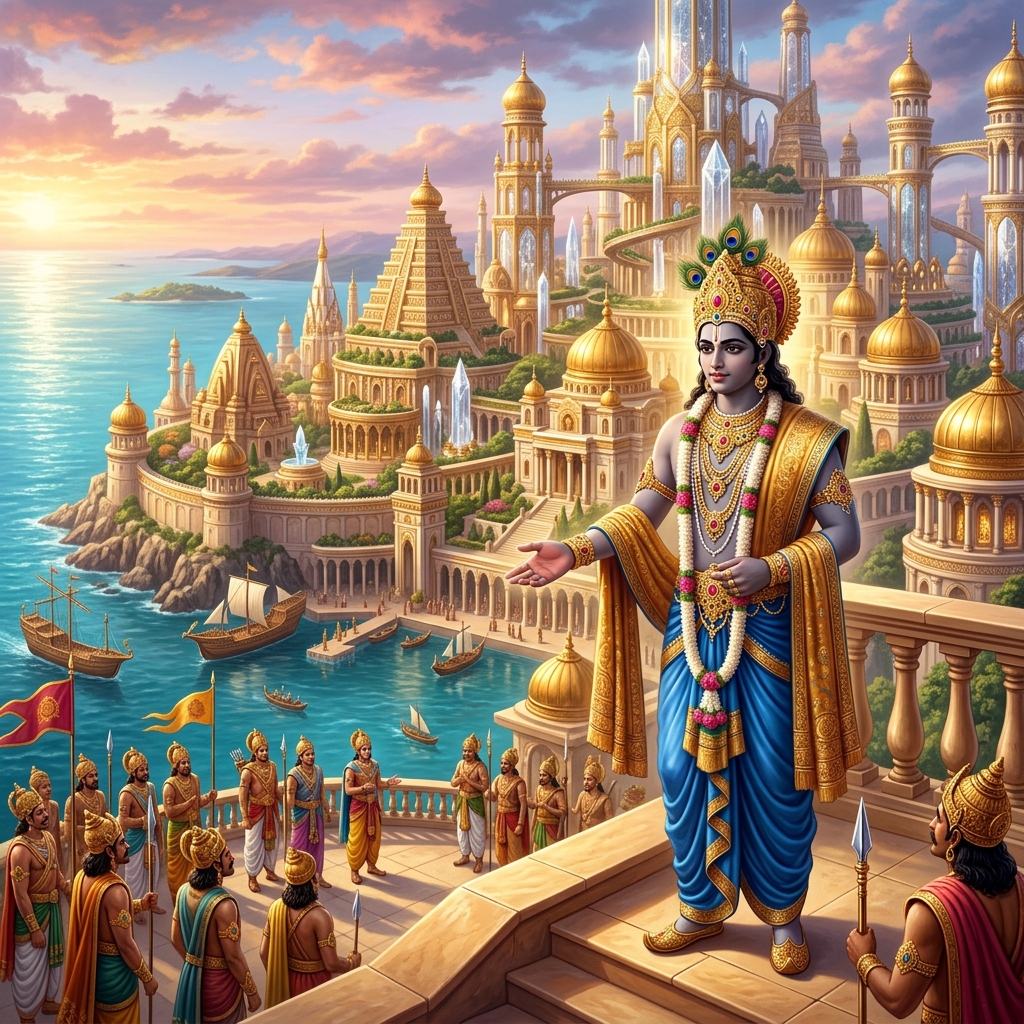
An Envoy from the Pundras
An envoy came to Dwaraka in the heat of the afternoon, his chariot road-worn, his manner stiff with the importance of the errand he carried. He asked leave to stand before Krishna in open court, and when it was granted he unrolled a scroll and read from it in a voice pitched for effect.
"Thus speaks Paundraka, king of the Pundras, sovereign of Karusha, Vasudeva in truth though the world in its confusion calls another man by that name: Krishna, you have worn my titles long enough. You have carried the conch Panchajanya, the discus Sudarshana, the mace and the bow that are mine by right of my incarnation, and you have let cowherds and kings alike bow to you as though you were god. I am the true Vasudeva. Lay down the discus and the conch. Renounce the emblems you have stolen. Come to me and bow, or I will come to Dwaraka with my armies and take from you by force what you refuse to surrender in humility."
The court fell silent for the space of a breath, and then it broke into open laughter - Satyaki struck his thigh, the elders shook their heads, and even the old counselors who prided themselves on gravity could not keep their faces still. Balarama laughed loudest of all and asked whether the king of the Pundras had gone mad from the Kashi sun.
Krishna alone did not laugh. He listened to the whole message without interrupting, and when it was finished he smiled, mild and unhurried, and answered the envoy directly. "Tell your king that he asks rightly for one thing. The discus is his, if he truly wants it. I will not send it. I will bring it myself, and place it in his hands." The envoy, uncertain whether he had been mocked or answered in earnest, bowed and rode back toward Kashi, and word went ahead of him that the impostor Krishna, as Paundraka called him, was already turning his chariot east.
The King Who Wore the Marks of God
In the city of Kashi, where his ally and admirer the old king had given him shelter and something worse than shelter, encouragement, Paundraka had spent years perfecting the image he wore. He dressed each morning in a robe of yellow silk cut to the pattern the poets gave to Vasudeva, and across his chest a craftsman had painted a curl of hair meant to pass for the Srivatsa mark that is said to rise naturally on the breast of the Lord. In his four arms, for he had persuaded artisans to bind two false limbs to his shoulders, he carried a conch cut from a white stone, a mace of gilded wood, a bow strung for show, and - the object of his particular pride - a discus of sandalwood painted to shine like Sudarshana itself.
He kept bards in his pay whose whole labor was to sing him as they would sing the Lord of the universe: "Victory to Vasudeva, creator and destroyer, before whom the false Krishna of Dwaraka trembles." He believed them, or had trained himself so long in believing them that the difference no longer troubled him. The old king of Kashi, whose friendship Paundraka valued above every other alliance, fed the delusion daily, calling him avatara before his own courtiers and promising his armies and his city gates to the cause the day Krishna's insolent reply reached them.
When the envoy returned and repeated Krishna's answer - that the discus was his if he wanted it, and that Krishna himself would bring it - Paundraka received the words as a confession of defeat. He put on his yellow silk, strapped his wooden weapons to his false arms, and told the king of Kashi to muster what soldiers the city could spare. "He comes to surrender," Paundraka said. "Let us receive him as a king receives a subject."
Krishna Rides to Kashi
Krishna did not summon the full strength of the Yadavas for what he told his charioteer would be a short errand. He and Balarama rode ahead of the army, the white horses of the chariot eating the road east toward the Ganga, and behind them at a slower pace came the divisions that would be needed only if the matter grew larger than one deluded king.
Word of the approach reached Kashi before the dust of the chariot did, and the city stirred as it had not stirred in a generation. Paundraka arrayed his forces outside the walls in the borrowed splendor of his four false arms, his sandalwood discus catching the sun, and the old king of Kashi stood beside him with his own soldiers, so that two crowns rode out together to meet what they had convinced themselves was a lesser god.
Krishna's chariot came to rest within sight of the Pundra lines, and for a moment neither side moved. Balarama, plough and mace close at hand, asked quietly whether this was to be a battle or a chastisement, and Krishna answered that it would be whatever Paundraka's own choice made of it. "He asked for the discus," Krishna said. "A promise, once given, is kept." Then he raised his hand, and Sudarshana - the true wheel, not the shape cut in wood - answered the summons and stood spinning in the air above the chariot, waiting.
Paundraka, seeing the true discus rise, did not retreat. Whether from a courage that was itself a kind of devotion, or from a delusion too complete to recognize its own end, he spurred his chariot forward and raised his wooden weapons as though sandalwood could answer fire.
The Discus Answers His Prayer
What followed was over swiftly and it was not comedy, though something like comedy had walked ahead of it through every year of Paundraka's preparation - the yellow silk, the painted mark, the bards singing praises meant for another. Sudarshana did not wait on ceremony. It left Krishna's raised hand and crossed the ground between the two chariots faster than any arrow, and it took the head from Paundraka's shoulders as cleanly as it had once taken heads from demons in older wars.
The false arms fell still bound to a body that no longer needed them. The wooden discus dropped from a hand that could not follow it, and the field, so recently loud with drums and the boasting of the Pundra host, went quiet.
Yet the tradition that carried this story forward insists on a mercy inside the slaughter, and it is the strangest teaching in the whole episode. Paundraka had spent his years thinking of Vasudeva without pause - dressing as him, speaking as him, dreaming of matching him, hating in him the very glory he coveted. Devotion that flatters and envy that seethes are not the same offering, but both keep the mind fixed without release on the same single point, and it is said that the form a man holds in his thought at the hour of death is the form he is carried toward. Paundraka, struck by Sudarshana, saw at the last the shape he had worn as costume become, for one instant, real above him. The tradition holds that his obsession, though born of vanity and rivalry, could not release him from the God it had fixed itself upon, and that he attained liberation - the imitator undone by the very discus he had demanded, and freed by the very obsession that had ruined him.
Balarama looked at the fallen king and said only that he had gotten, in the end, exactly what he asked for.
The Fire at the Gates of Kashi
The old king of Kashi did not long outlive the ally he had encouraged into ruin; grief and the shame of the defeat undid him within the season, and it was his son who took up the debt of vengeance. Untrained in reflection, and unable to accept that his father's champion had died a fool's death for a fool's claim, the young king turned to sorcery. He performed the rites that call up a krtya, a being wrought from ritual fire and set loose with a single purpose, and he sent it toward Dwaraka to burn the city that had orphaned his cause.
The krtya crossed the country as fire crosses dry grass, and for a time it seemed nothing in its path could turn it. But Sudarshana, which does not sleep and does not forget an old summons, met it before it reached the gates of Dwaraka. The discus that had already answered one deluded king's demand answered this second offense in the same coin, and where the sorcery-fire had come to consume, it was itself consumed. The wheel turned back along the path the krtya had burned and did not stop at the border of the enemy's ambition; it went on to Kashi, and by the time it returned to Krishna's hand the gates of that city had been opened to fire in turn.
What the story leaves behind, once the flames have settled into memory, is a teaching sharper than the swordplay that carried it. To dress in the forms of the divine out of vanity, to demand its weapons as trophies rather than receive them as gifts, ends the way every imitation of what one has not earned must end. And yet the same story insists that hatred is not outside the reach of grace if it cannot stop looking at what it hates - that even an enemy's unbroken gaze, fixed however wrongly on God, is a rope, and a rope, however it is gripped, can still be climbed home.
Dharma Lesson
Paundraka's imitation of Krishna, worn out of vanity and rivalry rather than devotion, brings only ruin to himself and, through the sorcery his ally's son unleashes, to Kashi as well. Yet the Harivamsa insists that a mind fixed without pause on the divine, even in envy or hatred, cannot fully escape it; Paundraka's obsession becomes, at the moment of death, the very thread that carries him toward liberation. The tale warns against imitating sanctity as costume while affirming that no gaze held steadily on God, whatever its motive, is wasted.