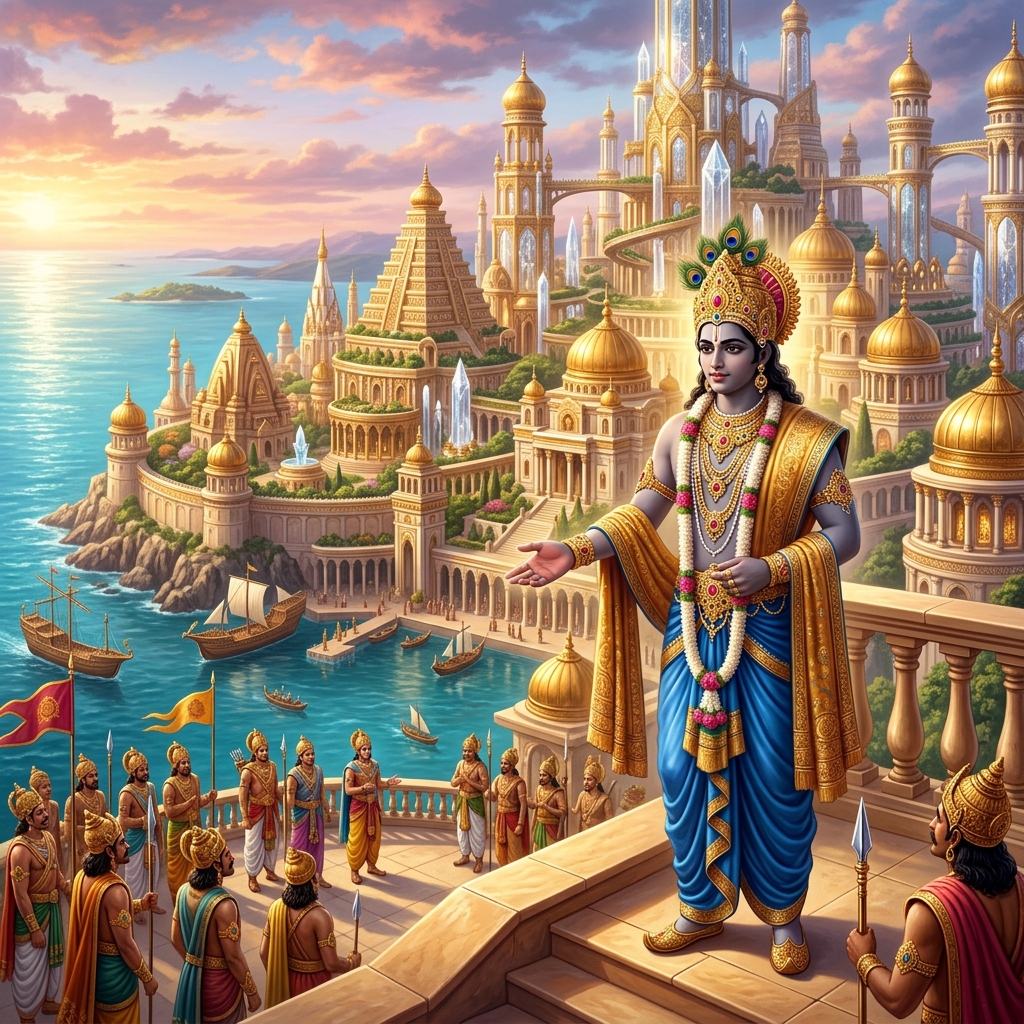
Eight Names in a Breath
Dwaraka counted eight chief queens, the ashta-bharya, and the tellers have always liked to name them in a breath, the way one names the eight directions: Rukmini, Satyabhama, Jambavati, Kalindi, Mitravinda, Satya, Bhadra, Lakshmana.
Three of them the world already knows. Rukmini was won by flight, carried out of her own wedding at her own written request. Satyabhama came to Krishna from her father Satrajit in the reckoning that followed the sun-jewel, and she is the one who later wanted the parijata tree and got it. Jambavati was given by the bear-king in the depth of his cave, when an immortal who had served Rama recognized his Lord after twenty-eight days of losing to him.
The other five are less told, and they are the reason this list is worth walking slowly.
Balarama, who watched the household grow with the resigned amusement of an elder brother, is supposed to have said that his brother had solved the problem of marriage by refusing to have one kind of it.
"They are not alike," he said. "That is what nobody outside this city understands. People hear eight and think of a number. There is no number. There are eight houses and eight lives and he is entirely inside each of them."
Because that is the peculiar claim the tradition makes about Dwaraka, and it makes it flatly and without embarrassment: that each queen's house knew Krishna wholly present. Not visiting. Not shared out in portions like a father dividing land. Undivided in division - the same paradox the philosophers work on with the sun in a hundred water-pots, told here as domestic fact, with the courtyards and the cooking and the quarrels included.
The eight stories do not rhyme. One woman wrote a letter. One was given by a bear. One sat in a river for years. One was carried off from a hall of angry brothers. One set a test of bulls. No two of them arrived by the same road, and the tellers insist on that, because it is the whole point of telling all eight instead of one.
The Daughter of the Sun in the Water
Kalindi was found, not won.
Krishna was walking the Yamuna's bank with Arjuna in the season when Arjuna was a guest in the west, the two of them out hunting and talking with the ease of men who have no business to settle. They came to a stretch of deep water, and there was a woman in it. Not bathing. Standing to the waist in the current, in the posture of a formal austerity, with the look of somebody who has been doing this for a very long time and intends to go on.
Arjuna, who had a courtier's manners, went and asked her who she was.
"I am the daughter of the sun," she said. "My name is Kalindi. My brother is Yama, who judges. I have made a house for myself in this water and I am doing tapasya here."
"For what?"
"For a husband." She said it without any coyness at all, as a woman states the object of a long labor. "I want Krishna of the Yadavas. I have wanted no one else and I will not have anyone else, and I will stand here until Vishnu gives him to me. Nobody has asked me to leave and I would not go."
Arjuna went back along the bank and reported it, word for word, and found that his friend was already walking down to the water.
The Harivamsa gives this arrival no drama, and the plainness is the beauty of it. There was no contest, no abduction, no defeated brothers, no test. There was a woman who had decided, and years of standing in a cold river to prove she had decided, and a man who came down the bank and gave her his hand and said, in effect, that she could stop now.
She came up out of the Yamuna and rode back to Dwaraka in his chariot. Her house there was famously quiet. She was the queen who never once asked for anything, having asked, in the water, for everything at once.
The Garland and the Seven Bulls
Mitravinda of Avanti did not stand in a river. She stood in a hall full of kings and made a public nuisance of herself.
She was Krishna's cousin - her mother was his father's sister - and she had grown up with the name in her ears and had settled her mind young. But she had two brothers, Vinda and Anuvinda, who held Avanti between them and had made their politics elsewhere, and they had told her plainly that whoever else she garlanded at the svayamvara, it would not be the Yadava.
She went to the hall. The suitors were ranked. She took the garland, walked the whole length of the ranks with her brothers watching, and put it on Krishna in front of all of them.
What followed was the loud kind of scene. The brothers refused to give her; the assembled kings, who did not need much encouragement, were happy to make it a fight; and Krishna took her out of Avanti through the middle of them, driving, with the princess of Avanti standing in the chariot beside him and holding on. He beat them off and did not kill her brothers, which is the detail the tellers keep, because he had to live with them afterward and so did she.
Satya of Kosala was a different problem, and a public one. Her father Nagnajit had seven bulls in his yard, and they were not ordinary bulls. They had gored men. Nobody had been able to put a rope on them, and the king had made a law out of his own helplessness: the man who yoked all seven would have his daughter, and no other man would.
Suitor after suitor had been carried out of that yard. When Krishna came, the princess Satya - Nagnajiti, the daughter of Nagnajit - had already spent years watching men fail on her account and had stopped enjoying it.
He went into the yard and made himself seven, and the seven took the seven bulls at once, and yoked them all in a single motion, and the noise the crowd made is said to have been heard in the next kingdom. Her father gave her with both hands.
"He did not tame them one at a time," she said afterward, "so that I would not have to watch it seven times."
The Cousin and the Arrow
Bhadra came without a contest of any kind, and her story is short because it is a happy one.
She was a princess of the Kekayas and another of Krishna's cousins, daughter of his father's sister Shrutakirti, and she had grown up in a house where the Yadavas were family and not politics. Her brothers, Santardana and the rest, thought the match obvious, arranged it themselves, and brought her west with a wedding party rather than an army. There was no svayamvara, no abduction, no yard full of bulls. She arrived on a good road in good weather and was received by her aunt's household as a girl coming home.
The tellers keep one thing about her: that she was the one the other queens went to. She had no story of her own to defend and no grievance of precedence, having been given by people who loved her to people who loved her, and so she was the room where a quarrel could be brought and set down.
Lakshmana of Madra was the last, and she was won by shooting.
Her father had set a test that anyone who has heard of Draupadi's wedding will recognize in outline, and the accounts differ on the details in the way accounts do: a target hung high, seen only by reflection, or seen not at all through a covering, and a bow that most of the hall could not string. Kings tried. Karna, some tellers say, came close. Arjuna was there and did not shoot, being a guest and knowing why he had come.
Krishna strung the bow, looked once, and hit it.
Lakshmana said afterward that she had prayed for exactly one thing during the whole affair, which was that it be over quickly, because she had watched a hall of men shooting at a fish for two days on the theory that this told her something about them.
"It told me nothing," she said. "The one who won was the one I would have chosen with no bow in the room at all."
Eight Houses, One Presence
The household that resulted was, by every account, loud.
Eight queens meant eight establishments, each with its own gate, garden, kitchen, treasury and staff, and each queen was sovereign inside her own walls in a way the outside world never quite grasped. Rukmini's house ran like a court. Satyabhama's ran like a campaign; she asked for things, got them, and asked for the next. Jambavati's kept the manners of the forest and served food nobody else in Dwaraka served. Kalindi's was so quiet that guests lowered their voices at the door. Satya's yard, inevitably, kept cattle.
They fought, in the way of a large family, and the fights are preserved with obvious affection: the long war over the parijata tree, whose flowers ended up growing in one courtyard and dropping their petals into another; the argument about who had waited longest; the day Narada came specifically to make trouble by asking each queen, separately, where her husband was, and got the same answer eight times and went away annoyed.
That is the story the tradition will not let go of. Each house believed itself to have him entirely, and each was right. He did not divide his evenings among them like a landlord; he was, in the claim the tellers make without blinking, wholly in each place, undivided in division, the way one sun stands whole in a hundred separate pots of water and none of them holds a piece.
And the eight roads matter as much as the one presence. One woman wrote a letter and was carried off. One was handed over in reparation. One was given by a bear in a cave. One stood in a river for years until he came for her. One defied her brothers in a public hall. One was won from seven bulls, one was simply brought home by people who loved her, and one was won with an arrow she never asked anybody to shoot.
The soul is wooed in as many ways as there are souls. The Lord does not have one road; he comes to each by the road that soul can walk, and arrives whole at every door.
Dharma Lesson
No two of the eight queens arrived by the same road, and the Harivamsa refuses to flatten them into a number: one wrote a letter, one was given in reparation, one stood in a river for years, one defied her brothers in open hall. The tradition reads the household of Dwaraka as a picture of the soul's approach to God, where the manner of coming is always particular and never repeated. And it insists that the presence received is not divided by being shared, as one sun stands whole in a hundred water-pots. The Lord comes to each by the road that soul can walk, and arrives whole at every door.