What the Young Man Asked For
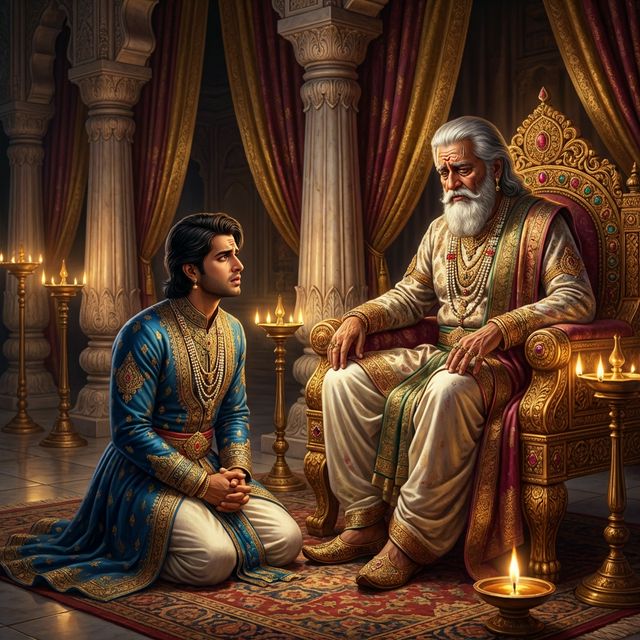
"You have told me twice since sunrise that you would rather take a bowl and walk into the forest than sit on that throne," said Bhishma from the bed of arrows. "Very well. I am not going to argue with you about it. I am going to tell you exactly what that life is, in the words of a man who actually lived it, and then you may choose it with your eyes open, which is the only way a thing is worth choosing."
His name was Harita, and he was a sage of the old kind, and he was asked once by a young man of good family who had come to him full of enthusiasm what the rule was for one who had left the world.
"You want the rule," said Harita. "Most men who come to me want the feeling. They have read something, or they have been badly hurt, and they have conceived a great tenderness for the idea of freedom, and they imagine that renunciation is chiefly a matter of walking away from a house. Walking away from a house takes one afternoon. Anybody can do it. Half the men on the roads have done it and not one thing has changed in them; they have simply moved their quarrel outdoors.
"The rule is not about the house. The rule is about the ten thousand small occasions on which a man is invited, every single day, to be somebody. That is what you have to leave, and it does not stay behind in the village. It follows you out and it is waiting on the road at the first house where you beg.
"So the rule is exact. It is exact on purpose. Every clause of it looks petty and every clause of it is aimed at the same animal, and if you keep nine of them and leave out the tenth, the animal lives in the tenth quite comfortably and grows fat there, and you will find you have walked a thousand miles to become a proud beggar, which is worse than an ordinary householder in every respect and much harder to correct.
"Listen, then, and do not be charmed by it. There is nothing charming in it anywhere."
The Rule of the Bowl
"Begin with the bowl," said Harita, "because the bowl is where a renunciate is most often lost.
"He shall beg. He shall not earn, store, plant or keep, and so he must beg, and begging is not humility; a man can beg for forty years and be as swollen as a prince. So it is governed.
"He asks once. He stands at the door, he makes his need known plainly, and whatever comes he takes without comment. If nothing comes he goes on to the next house without changing his face and without any remark to himself about that house, because the remark is the thing that will ruin him and not the hunger.
"He does not greet the giver twice. He may say what is proper and no more. He does not praise the household, he does not admire the gate, he does not ask after the health of the master's son whose name he has taken care to remember. Every one of those is a small purchase of a larger portion, and the man who makes them has not left commerce, he has only exchanged a shop for a doorstep. And he does not return tomorrow to the door that gave generously today. Generosity, once discovered, will pull a man back to the same three houses within a month, and then he has a livelihood again, and a position in a street, and people who expect him.
"He begs after the smoke has gone from the roofs, when the household has already eaten, so that what he receives costs nobody a meal.
"And he eats as a sick man takes medicine. Not gratefully, not resentfully, not with attention to the taste. Food is what keeps the body walking and it has no other business with him. He does not remember at the next door that the previous house gave sweet things, and he does not let his feet carry him back there while he tells himself he is going that way anyway. If what is given is coarse he eats it. If it is delicious he eats the same quantity and does not think about it afterwards, and the not thinking about it afterwards is the whole of the practice, and it is harder than fasting, which is why men prefer to fast."
Never Twice Under One Tree
"Now the sleeping place," said Harita, "and this clause is the one the young always argue with.
"He does not lie down twice under the same tree. He does not keep a cave, or a hut, or a favourite bend of the river with a flat stone in it. One night in a place and then he moves.
"You will say the rule is arbitrary, and that a tree is not property. A tree is not property. But sleep under it a second time and it becomes his tree. On the fourth night he will have improved it slightly. By the tenth he will feel something when he finds another man sitting in its shade, and that feeling is precisely the thing he came out here to be rid of, and it will have grown back out of nothing at all, out of shade and habit, in ten days. The rule does not distrust the tree. It distrusts him, correctly.
"He owns the bowl, the cloth, and a staff if his knees require one. He does not own a second of anything. He does not go into a village for the sake of going into a village, and when he passes through he does not learn the news.
"And he draws in the senses as a tortoise draws in its limbs. That is the image and it is a precise one. The tortoise is not maimed; every limb is still there, and it puts them out again when it must walk. It simply does not leave them out where anything can take hold of them. So with the eye, which will follow a passing woman or a fine horse or a well-kept doorway; with the ear, which will lean toward its own name spoken in a crowd from fifty paces; with the tongue, which is the worst of them and wants both flavour and conversation.
"He is guarded by that. Not walled off from the world, which is impossible and would be no achievement if it were possible. Guarded, the way a man walks through a market with his purse inside his coat, still walking, still looking, but not offering."
Praise, Blame and the Wages
"Then the hardest clauses," said Harita, "which are the ones about other people, and about the end.
"He is the same under praise and under insult. Understand what is being asked. Not that he should endure abuse with a set jaw, which is only pride wearing armour, but that the two should genuinely weigh the same in his hand. Men will call him a holy one and touch his feet, and men will call him a lazy fraud eating the food of workers, and both are describing a person he has agreed to stop being. If the praise gives him pleasure, then the insult has already been granted its power, because they are one coin and a man does not get to accept only the face of it.
"He wishes no creature ill, including those who have injured him, and he does not conduct arguments in his head at night, which is where a renunciate does most of his sinning.
"He neither loves life nor hates it. Both are a strong opinion about the same thing. The man who loves life will do something shabby before the end to keep hold of it, and the man who hates it is in a great hurry, and hurry is a passion like any other. He is not longing for death and he is not fleeing it.
"He waits for his hour the way a hired servant waits for his wages at the end of the day. Consider that man. He does not stand at the door of the house from noon onward, watching. He does not spend the afternoon resenting the delay, or dreading it, or working out how to bring it forward. He works. The evening comes when it comes, and the wage is paid, and he goes home. He has done nothing all day about the wage except earn it.
"That is the whole posture toward death. Not courage, which is loud, and not indifference, which is a pose. Simply the settled expectation of a man who knows the terms of his employment and has no anxiety about the master's honesty."
Harita's Heart in a Palace
"Now hear the point of it," said Bhishma, "because Harita's rule is not a list of austerities and it was never meant to impress anybody.
"Every clause in it does one thing. It removes an occasion. Do not go twice to the generous door, and the occasion to be a favourite is gone. Do not praise the giver, and the occasion to be charming is gone. Do not sleep twice under one tree, and the occasion to have a place is gone. Do not lean toward your own name, and the occasion to be a reputation is gone. The self a man carries about with him does not live on grand things. It lives on occasions, and it can live on very small ones, and if you leave it three a day it will manage perfectly well on three.
"So the outer discipline exists to starve it. That is all. A man does not become free by concluding that he is free. Freedom is not an opinion arrived at one evening; it is a practice kept in ten thousand small hours, and the practice is dull, and it is the whole difference between the two kinds of man who leave the world.
"And now the turn, son of Kunti, and I want you to feel the weight of it.
"You cannot keep Harita's rule. Not one clause of it. You must sleep in the same room for thirty years, and you must eat what is set before a king, and you must be praised in the assembly to your face by men who need something, and you must hold the treasury, and the granaries, and the roads, and the army, and every day people will come to you and put more into your hands.
"But you can keep Harita's heart while you do it. Own everything and cling to nothing. Let the palace be a place you sleep in and not a place you are. Take the praise the way he takes a full bowl and the abuse the way he takes an empty one, and give the judgment honestly to the man whose son insulted you last winter.
"That is your forest. There is no other one available to you. And it is harder than his, which is why I have kept you sitting here so long while I explained it."
Dharma Lesson
The renunciate's outer rules are not austerities for their own sake; each one removes an occasion on which a man would otherwise be invited to be somebody, and the self that was left behind in the village lives very well on three such occasions a day. Freedom is therefore a practice kept in small dull hours, not an opinion arrived at one evening. A king can keep none of Harita's clauses, since he must sleep in one room, hold the treasury and be praised to his face. He can still keep Harita's heart: own everything and cling to nothing.